
The rationale behind 11 Plus Verbal Reasoning being the topic that determines grammar school destinations.
Master 11 plus verbal reasoning with expert tips, question type breakdowns, and proven strategies. Complete guide for CEM 11 plus and GL Assessment 11+ verbal reasoning preparation in 2026.
The rationale behind 11 Plus Verbal Reasoning being the topic that determines grammar school destinations.
Among all the topics to be assessed by the 11-plus exam, verbal reasoning had the most consistent results for the children who end up in grammar school and those who are rejected. It is not due to the fact that verbal reasoning is the most difficult of subjects in an absolute sense. It is due to the fact that it is the most unknown. Children who take the 11+ verbal reasoning paper in the first instance may freeze, not due to lack of ability, but due to lack of exposure to that kind of question in school. Verbal reasoning is not taught in primary schools. Children are not taught in the curriculum. That disconnection between school curriculum and school entrance exam requirements is exactly where drilled practice is most likely to help.
This guide provides you with the professional knowledge of 11 plus verbal reasoning that most families take months to put together individually. When your child is aiming at grammar schools in 2026, be it by the GL Assessment 11+, the CEM 11 plus, or the SET exam, what follows will alter the way you treat this subject henceforth.
What Is 11-Plus Verbal Reasoning, and What Does It Test?
11-plus verbal reasoning tests check the level of language comprehension, recognition of patterns in words and letters, and applying logical principles to resolve language-related problems in a child with a lot of time pressure. It is not a spelling test. It is not a grammar test. It is not a reading comprehension paper. It is completely different: a test of the speed and precision with which a child is able to manipulate language on a structural level.
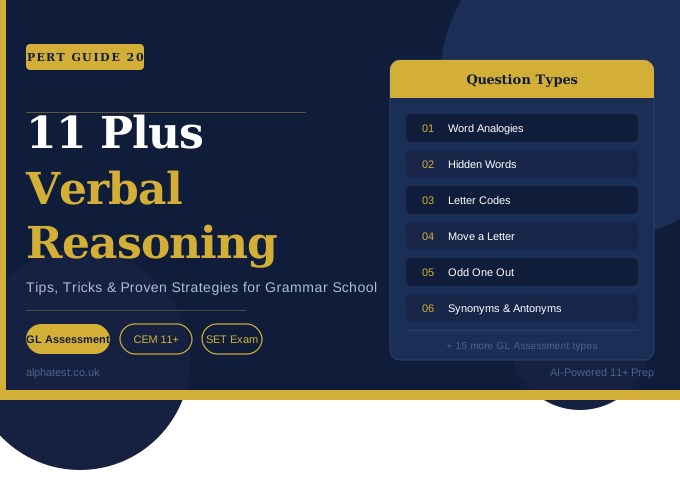
GL Assessment 11+ contains 21 types of verbal reasoning questions published. These include word analogies, in which a child has to discover a connection between one set of words and transfer it to another; letter sequence codes; hidden word problems; move-a-letter puzzles; formation of compound words; and finding synonyms and antonyms. The logic of each type of question and the method of finding an answer are different. A child who has not been taught to learn to identify these types will immediately take valuable seconds to figure out what is being requested and even have started to answer.
The verbal reasoning paper, CEM 11 plus, works in a different manner. Instead of providing question types in a set of expected pairs, CEM intermingles questions of verbal reasoning with reading comprehension on one timed paper. The types of questions themselves are not listed, a design decision aimed at rewarding real language proficiency as opposed to familiarity with format. CEM 11-plus verbal reasoning children should be capable of flexibly thinking under pressure, alternating between types of questions without notice, and without a slowed pace.
Knowing what board your child will be on is thus the initial and most crucial step in any verbal preparation 11+ program.
The 6 most important GL assessment verbal reasoning types of questions.
With families aiming at GL Assessment 11+ grammar schools—in Kent, Buckinghamshire, Essex, Hertfordshire, and most independent schools—the key preparation activity is to master the 21 types of questions. The most common six types that appear and have the highest percentage of marks.
Word analogies are tests to determine whether a child can recognize the exact relationship between two words and generalize the relationship to a new pair. The association may be that of cause and effect, part/whole, synonym, antonym, membership of categories, and/or degree of intensity. Those who have difficulties with analogies are virtually those children who have not read sufficiently to learn the subtle relations of words intuitively.
Hidden word questions are sentences where a word of four letters is buried at the edge of two consecutive words—the end of one word and the beginning of the next word. Everything here is speed. Children who have practiced extensively this type are able to read a sentence and find the hidden word within a short period of less than five seconds. The unlucky ones can devote twenty seconds of their time to a question that has one mark.
Code question: Letter code questions are questions that have a word written in a code in which each letter has been moved by a fixed number of spaces in the alphabet and require the child to decode a new word using the same rule. These reward kids that are comfortable with alphabetical orders and could move through the alphabet fast in either direction. Daily alphabet exercises -writing the alphabet both forward and backward and recognizing the relative position of each letter -are boring, but yield tangible results of accuracy and speed in this type of question.
Move-a-letter questions are those in which children are requested to take out a single letter in a word and place it in another word in order to form two new words that are valid. This involves a good vocabulary and multiple possibilities for working memory. The algorithm is strategic: attempt to delete letters of the first word one by one and then attempt to insert them in each spot of the second word and see whether the resulting word is a valid one.
Questions that are odd-one-out introduce a set of five words and require the reader to answer which one is out of place. The pitfall of these questions is that the most apparent category grouping can be the one the question is testing. A child answering too fast will often fail to find a more hidden relationship between four out of five words and leave the fifth word out.
The most vocabulary-related questions on the GL Assessment verbal reasoning paper are synonym and antonym questions. A child with 3,000 words of knowledge will win over the one with 1,500 words of knowledge in these questions no matter how long the two took in the practice papers. No shortcuts in this. The vocabulary should be developed gradually over time by wide reading and conscious daily learning.
The most effective preparation strategy for the 11 Plus Verbal Reasoning.
The majority of families prepare 11-plus verbal reasoning backwards. They purchase exercise papers, place the child in front of them, make a mark in the answers, write down the score, and proceed to the next paper. This method generates familiarity with the exam format but fails to reliably develop the underlying skills that verbal reasoning tests.
The difference in preparation strategy adopted by expert tutors is critical in one aspect: all wrong answers are seen as a diagnostic rather than a disappointment. In cases where a child gives a verbal reasoning question the wrong answer, the question will not be what is the correct answer but why did this child give the wrong answer? A child who has misread the question requires different remediation as compared to a child who simply did not know the meaning of one of the key words, who in turn requires different remediation compared to a child who used the wrong approach to the correct question type. The most wasteful thing that families do during verbal reasoning 11-plus practice is to treat all wrong answers equally by presenting the correct answer and moving on.
Take at least the same amount of time to review mistakes after each practice session as you took to do the paper. Each time we give a wrong answer, find the cause. Target that cause specifically, then, in the following session.
Developing the Vocabulary Foundation Needed in Verbal Reasoning.
A serious vocabulary program cannot be left out of any preparation strategy of 11-plus verbal reasoning. Such terms as "abundant," "alleviate," "articulate," "belligerent," "calamity," "diligent," "eloquent," "meticulous," and "resilient" are common words that occur in verbal reasoning papers as well as in passages that assess comprehension. A kid who has first met such words in the exam room is at a dead end.
The best way to build vocabulary is also the easiest: five new words daily, memorized with meaning, a synonym, an antonym, and a sentence in which the word is used. This translates to more than 2,500 active vocabulary words for a child over eighteen months of preparation—a linguistic benefit that cannot be simulated even by a year of paper drilling before the test.
Wide reading enhances vocabulary growth at a very high rate. When a child reads good fiction, good non-fiction, and a good children newspaper/magazine, they are exposed to new words in meaningful contexts multiple times, and this is the state in which words transfer out of passive awareness into active, useful knowledge. This type of living vocabulary, where the words are known in depth and not merely words read and stored in memory, is precisely what is being rewarded in the 11 plus verbal reasoning papers.
Timing and Pacing: The Most Preparation Program That is Ignored by Skills.
Any veteran eleven plus verbal reasoning tutor will inform you that a lot of children that fail to get the required score are not children who are ignorant. They are children that outgrew their times. Verbal reasoning papers—especially CEM 11 plus verbal reasoning papers—are set in a way that even well-prepared children have a hard time in. When a child takes thirty seconds to answer one question, he or she is already lagging behind the schedule of doing the paper.
Rushing is not the answer. It is to train consciously to timed conditions early in the practice process so that speed becomes a habit, not an emergency. Since approximately January of Year 5, all of the verbal reasoning practice sessions need to have at least some form of a timed component. At the end of the summer of Year 5, children are expected to sit for full-timed papers and not only track accuracy but also questions per minute in each type of question.
It is always best to proceed and come back when a question is not coming. There is no point to waste sixty seconds contemplating one challenging question. The child who will respond to ninety questions correctly out of a hundred will nearly always perform better than the child who will take three minutes to answer question seven correctly.
Begin to develop your child verbal reasoning.
Verbal reasoning 11 plus is not a gifted ability that children possess or lack. It is an art, which is a direct, measurable reaction to intelligent, concentrated training. The most successful children do not have to be the most naturally gifted ones; they are the ones who began early, practiced regularly, were taught to develop real vocabulary, and were taught to spend their time in real exam conditions.
AlphaTest includes all verbal reasoning question types of GL Assessment and CEM 11 Plus with AI-driven adaptive practice, which modulates difficulty dynamically. Take a free assessment today to see just what types of verbal reasoning questions your child has already perfected and what type of questions require special emphasis before the test.
Start the free verbal reasoning test of your child at AlphaTest →
Ready to boost your child's 11+ preparation?
Try AlphaTest free — AI-powered practice, instant feedback, and gamified learning.
Start Free Trial