
How to Prepare for the 11 Plus in 6 Months: A Step-by-Step Plan for 2026
Starting 11 plus preparation with just 6 months to go? This expert step-by-step plan covers every subject, every exam board and every week — so your child walks into the grammar school entrance exam fully prepared.
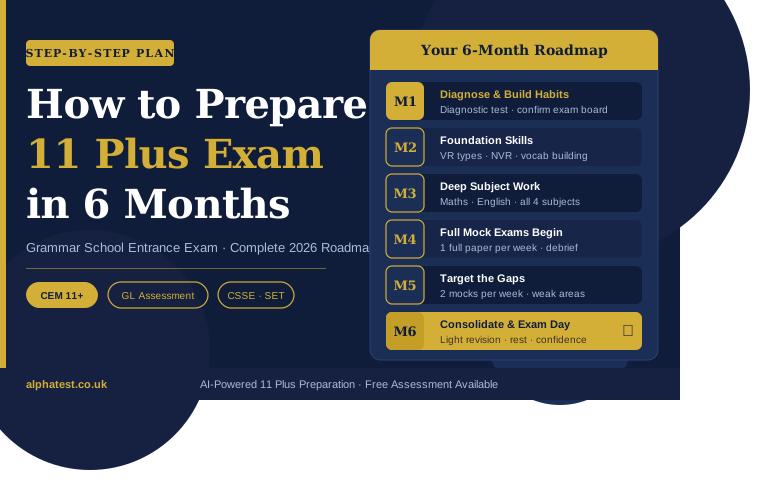
Six Months Is Enough — If You Use Them Correctly
The most common question parents ask once they realise the 11 plus exam is approaching faster than expected is a simple one: is it too late? The answer, in most cases, is no. Six months of focused, well-structured 11 plus preparation is sufficient for the majority of children to reach a competitive standard — provided those six months are used intelligently rather than chaotically.
The families who waste six months are the ones who buy a stack of practice papers, sit their child in front of them every weekend, and hope that volume alone produces improvement. It does not. The families who succeed in six months are the ones who treat preparation as a skills-building programme: identify the gaps, target them specifically, build confidence through progressive challenge, and arrive at exam day having practised in conditions that genuinely replicate the real thing.
This plan gives you the exact structure to do that. It is built around four core subjects — 11 plus verbal reasoning, 11+ non-verbal reasoning, 11 plus English comprehension, and 11 plus maths practice — and is applicable whether your child is sitting the CEM 11 plus, GL Assessment 11+, CSSE exam, or SET exam. Adjust the specific question types you focus on based on your target exam board, but keep the overall structure intact.
Week 1 to 2: Diagnose Before You Prepare
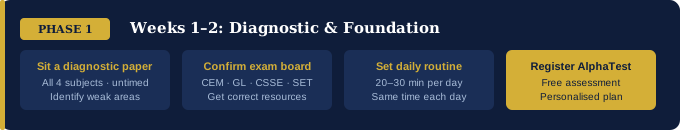
The single biggest mistake families make when beginning late 11 plus preparation is starting with a practice paper in the format they hope their child will eventually sit, marking it, noting the score, and then buying more papers of the same kind. This is preparation by hope. What actually works is beginning with a diagnostic — a deliberate, analytical assessment of exactly where your child stands right now across every subject area.
In the first two weeks, sit your child a sample paper in each of the four core subjects without any time pressure. The goal is not a score. The goal is a map: which verbal reasoning question types are already understood, which non-verbal reasoning categories are unfamiliar, whether maths gaps exist in specific topic areas, and how strong reading comprehension genuinely is under exam-style conditions. Once you have this picture, every subsequent session targets something real rather than something assumed.
This is also the week to confirm, with absolute certainty, which exam board your target grammar schools use. Check each school's admissions page directly. A child sitting the CEM 11 plus needs a fundamentally different preparation approach from one sitting the GL Assessment 11+. Getting this wrong at the start and discovering it three months later is a genuinely serious setback.
AlphaTest's free diagnostic assessment does this automatically across all four subjects, producing a detailed report of strengths and gaps within minutes. For families beginning a six-month plan, this is the smartest possible starting point.
Month 1: Building the Foundations
With the diagnostic complete and the exam board confirmed, Month 1 is about establishing habits and filling the most significant gaps identified in the first two weeks. The rhythm of preparation — short, daily, focused sessions — must become routine before intensity increases. A child who is not yet in the habit of daily practice will not suddenly sustain four or five sessions per week when the pressure rises in Month 4 and Month 5. Build the habit now, while there is still time to do it gently.
For 11 plus verbal reasoning, Month 1 should focus on the question types your diagnostic identified as weakest. For GL Assessment families, work through those specific types from the 21 published categories — one type per session, with the method explained clearly before practice begins. For CEM 11 plus families, focus on mixed vocabulary and comprehension practice, building the language fluency that the CEM format rewards above all else.
For 11 plus maths practice, the first priority is always times tables. If these are not automatic up to 12 × 12 by the end of Month 1, everything else in the maths preparation becomes significantly harder. Five minutes of daily mental maths drill, run as a game rather than a test, builds this automaticity without the resistance that formal drilling often produces in children.
For 11+ non-verbal reasoning, introduce the concept of matrices — the most commonly appearing NVR question type across all exam boards — and establish the habit of working through each visual problem systematically rather than guessing. NVR improves faster than almost any other subject with focused practice. Many children who begin Month 1 finding matrices confusing are answering them confidently by the end of Month 2.
For 11 plus English comprehension, the work in Month 1 is primarily reading. Thirty minutes of daily reading — quality fiction or non-fiction, chosen in consultation with the child — must become as non-negotiable as the practice sessions themselves. No amount of comprehension paper practice compensates for a narrow vocabulary and limited reading experience when inference questions arrive.
Month 2 and 3: Systematic Subject-by-Subject Development
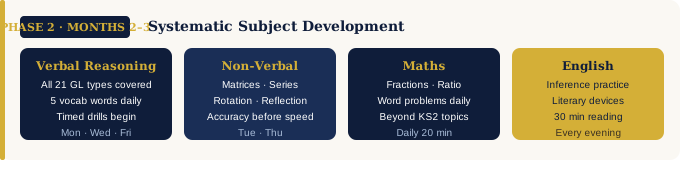
Months 2 and 3 are the engine room of the entire six-month plan. The diagnostic is done, the habits are established, and now the work deepens across every subject simultaneously. Sessions increase to four or five per week, each lasting 25 to 35 minutes. The weekly structure should rotate subjects so that no single area goes unvisited for more than two days.
For GL Assessment 11+ verbal reasoning preparation specifically, every one of the 21 question types must be covered systematically during these two months. Work through two or three types per week, spending multiple sessions on each before moving on. The temptation is to rush through unfamiliar types and spend more time on the ones a child already handles confidently. Resist it. The marks lost to weak question types in the exam cannot be recovered by perfect performance on the strong ones.
Vocabulary building enters its most important phase during Month 2 and 3. Five new words per day — learned with definition, synonym, antonym, and a sentence in context — is the target. An 11 plus vocabulary list maintained in a dedicated notebook, reviewed weekly, turns passive word recognition into active knowledge. High-frequency words like meticulous, resilient, eloquent, tenacious, benevolent, and formidable should be embedded by the end of Month 3 so thoroughly that they feel completely familiar when they appear in exam questions.
For 11 plus maths practice, Month 2 moves beyond times tables into the topic areas most commonly tested in grammar school entrance exams: fractions, decimals, percentages, ratio, algebra, area, perimeter, and multi-step word problems. Work through one topic area per week, using CGP or Bond books as the primary resource, then consolidate with mixed topic questions to prevent the silo effect — where a child can answer a percentage question when they know it is a percentage question but fails when it appears in a mixed context without labelling.
The most important shift in 11 plus English comprehension preparation during Month 2 and 3 is moving from general reading into deliberate inference practice. After reading a passage, ask your child questions that cannot be answered by copying text directly: what does the author want the reader to feel here? What does this word choice tell us about the character's state of mind? Why did the author end the paragraph here? These conversations, held regularly over two months, build the analytical reading habit that comprehension papers test.
Month 4: Introduce Full Mock Exams
Month 4 is when preparation shifts from skills-building into exam-readiness. The defining feature of this month is the introduction of full-length 11 plus mock exams — complete papers, sat in sequence, under strict timed conditions, without help. This is non-negotiable. A child who has practised every question type individually but never sat through a full examination sitting does not know what exam conditions actually feel like. They do not know how their concentration changes across multiple papers, how their pace holds up when tiredness sets in, or whether they can maintain accuracy under the compound pressure of real timing.
Sit one full mock exam per week during Month 4. After each mock, spend at least as long reviewing mistakes as the papers took to complete. For every wrong answer, identify whether the cause was misreading the question, not knowing the method, weak vocabulary, or simply poor time management. Each cause requires a different response in the following week's targeted practice sessions.
AlphaTest's mock exam platform replicates real exam conditions digitally and provides instant question-by-question analysis after each sitting — identifying patterns of error that manual paper marking routinely misses. For families in Month 4 of a six-month plan, this level of diagnostic detail is genuinely valuable.
Month 5: Target the Gaps That Mock Exams Reveal

By Month 5, mock exam data tells you more about your child's preparation than any other source. Use it ruthlessly. List every question type or topic area where accuracy falls below 80 percent. Rank these by how frequently they appear in the exam. Then allocate at least 60 percent of Month 5 practice time specifically to the weakest areas in that ranked list.
This feels counterintuitive. Most children — and most parents — gravitate naturally toward practising the things a child already does well. Strong verbal reasoning becomes the focus because it generates correct answers and feels rewarding. Weak non-verbal reasoning gets avoided because it generates wrong answers and feels discouraging. This instinct, however understandable, actively undermines preparation. The marks available in a weak area are worth exactly as much as the marks available in a strong one. Improving accuracy in the bottom three question types from 50 percent to 80 percent will always add more marks to the total score than pushing a strong area from 88 percent to 92 percent.
Increase mock exam frequency in Month 5 to two full sittings per week. By this point, the full-paper experience should feel familiar enough that the child's performance is genuinely representative of their ability rather than distorted by exam-condition anxiety.
Month 6: Consolidate, Calm, and Prepare for the Day Itself
The final month before the 11 plus exam is not the time to introduce new material, increase pressure, or attempt dramatic improvement. It is the time to consolidate everything that has been built over the previous five months, maintain sharpness through continued practice, and focus deliberate attention on the emotional and practical preparation that exam day itself demands.
Reduce practice sessions to three per week during the final month. Keep them short — 20 to 25 minutes maximum. Focus exclusively on question types where confidence is already high, to reinforce positive momentum rather than expose gaps that cannot now be meaningfully addressed before exam day. One full mock exam per week is sufficient to maintain pace and timing sharpness without producing the exhaustion that daily paper-sitting can generate.
In the final two weeks before the 11 plus exam dates 2026, shift focus away from papers entirely. Light vocabulary review, a few familiar question types, and plenty of rest. The preparation is done. A child who has followed this plan for six months has built real skills, real vocabulary, and real exam-condition experience. The final weeks are about confidence, not cramming.
On the night before the exam, no practice at all. Early dinner, early bed, eight to nine hours of sleep. On the morning of the exam, a good breakfast, a calm journey, and a parent who appears completely relaxed — because children read parental anxiety more accurately than parents realise, and carrying that anxiety into the exam room costs marks.
Start your child's six-month preparation plan today with a free diagnostic assessment at AlphaTest →
Ready to boost your child's 11+ preparation?
Try AlphaTest free — AI-powered practice, instant feedback, and gamified learning.
Start Free Trial