
11 Plus Exam 2026: The Complete Preparation Guide for UK Parents
Everything UK parents need to know about the 11 plus exam. CEM 11 plus, GL Assessment 11+, CSSE exam, SET exam, verbal reasoning, non-verbal reasoning, English comprehension and maths practice. Free tips, past papers advice and study plans.
What Is the 11 Plus Exam and Why Does It Matter?
Every September, tens of thousands of children across England sit one of the most consequential tests of their young lives. The 11 plus exam — also written as 11+ or eleven plus — is the selective entrance examination used by grammar schools and many independent schools to identify academically able pupils before secondary school entry. It is taken by children aged 10 to 11, typically in Year 6, though 11+ preparation must begin long before that if a child is to have a genuine chance of success.
The grammar school entrance exam was first introduced in 1944 as part of the Butler Education Act. Today, around 163 state grammar schools remain in England, concentrated in selective areas including Kent, Buckinghamshire, Essex, Sutton, Trafford, Birmingham, Lincolnshire, Gloucestershire, and Slough. Each of these regions uses a slightly different version of the eleven plus, administered by one of four main exam boards. Understanding which board applies to your target schools is the single most important first step any family can take.
For parents beginning this journey, the landscape can feel overwhelming. There are different exam formats, different subjects, different pass marks, different registration deadlines, and an enormous industry of books, tutors, online platforms, and practice papers all competing for your attention and money. This guide cuts through all of that. It covers every exam board, every subject, honest preparation timelines, and practical advice on how to give your child the best possible chance — without burning them out before they even sit in the exam room.
AlphaTest offers a free personalised assessment that tells you exactly where your child stands across all four 11 plus subjects, making it a smart first step before you invest in books, tutors, or a preparation plan.
The Four 11 Plus Exam Boards: What Every Parent Must Know First
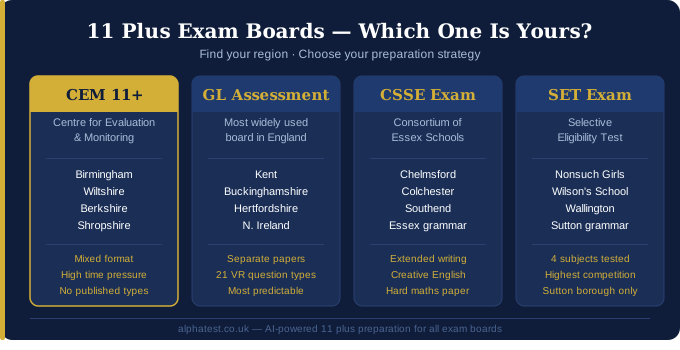
Before purchasing a single practice paper or booking a tutor, you must confirm which exam board your target grammar schools use. This is not a minor detail — it determines everything about how you prepare. The CEM 11 plus, GL Assessment 11+, CSSE exam, and SET exam differ significantly in format, timing, subject coverage, and the skills they reward. Preparing for the wrong format is one of the most common and costly mistakes families make.
CEM 11 Plus
The CEM 11 plus is produced by the Centre for Evaluation and Monitoring at Durham University. It is used across several selective regions including Birmingham, Wiltshire, Berkshire, Shropshire, Dorset, and parts of the North East. If your target grammar schools are in any of these areas, the CEM exam is what your child will face.
What makes the CEM 11 plus genuinely distinctive — and genuinely difficult to prepare for in a traditional way — is its deliberate mixing of question types within a single paper. Rather than sitting a separate verbal reasoning paper followed by a separate maths paper, children taking the CEM 11 plus encounter questions from different subjects interwoven throughout the same test. Verbal reasoning, reading comprehension, and numerical reasoning appear in the same sitting, in an order the child cannot predict. This requires a kind of mental flexibility that rote drilling of individual question types simply does not build.
CEM also does not publish its official question types, which means there is no definitive list to work through. This is intentional — the exam was designed specifically to reduce the advantage that intensive tutoring gives in more predictable formats. A child who has read widely, thinks mathematically, and remains calm under pressure will perform better in a CEM 11 plus than a child who has drilled 500 verbal reasoning papers but never developed genuine language intuition.
The CEM exam also places extraordinary pressure on time. Children who have not practised under strict timed conditions find themselves running out of paper long before they run out of ability. Pace is a skill that must be built deliberately, not assumed.
For CEM 11 plus preparation, the most effective approach combines daily wide reading with regular mixed-format timed sessions — not subject-by-subject drills. Mental maths automaticity matters enormously here. A child who has to stop and think about 8 × 7 under CEM conditions is already behind.
AlphaTest's AI-powered platform adapts its question format to match whichever exam board your child is targeting. For CEM preparation specifically, it blends question types across subjects in mixed sessions — replicating the real exam experience rather than giving false confidence through single-subject drills.
GL Assessment 11 Plus
The GL Assessment 11+ is the most widely used 11+ exam board in England. Grammar schools in Kent, Buckinghamshire, Essex, Hertfordshire, and Northern Ireland use GL Assessment papers, as do a very large number of independent schools across the country. If you are researching the Kent Test, the Buckinghamshire 11 plus, or Essex 11 plus grammar schools, GL Assessment is almost certainly the format your child will sit.
Unlike the CEM 11 plus, the GL Assessment 11+ uses clearly separated papers for each subject. Children typically sit dedicated papers for verbal reasoning, non-verbal reasoning, English, and maths — each assessed independently, each with its own time allowance. This structure, combined with GL's 21 published verbal reasoning question types and clearly defined non-verbal categories, makes the GL Assessment 11+ significantly more responsive to systematic preparation.
This is both an advantage and a risk. The advantage is that a child who works methodically through every GL question type — learning to recognise each one instantly and apply the correct method reliably — builds a genuine and measurable edge. The risk is that some children become so accustomed to practising in a single-subject format that they struggle to maintain pace and focus across a full sitting of multiple papers. Full mock exam practice — sitting all papers back to back in realistic exam conditions — is essential from at least January of Year 5 onwards.
GL Assessment 11+ past papers and practice materials are widely available commercially, through CGP, Bond, and First Past the Post among others. Free 11+ practice papers in GL format are also available from several online resources. The depth and variety of available material is one of the reasons GL preparation is more straightforward than CEM preparation for most families.
For Buckinghamshire 11 plus and Kent Test preparation in particular, the competition is fierce and pass marks are high. Beginning structured preparation no later than the start of Year 4 gives children in these areas the time they need to reach the required standard comfortably rather than desperately.
CSSE Exam
The CSSE exam is administered by the Consortium of Selective Schools in Essex and is used exclusively by Essex grammar schools including Chelmsford County High School for Girls, King Edward VI Grammar School Chelmsford, Colchester County High School for Girls, and several other consortium schools. If Essex 11 plus grammar schools are your target, the CSSE exam is what your child will face — and it is a different beast from both CEM and GL.
The defining characteristic of the CSSE exam is its heavy emphasis on extended written English. Unlike GL Assessment, where English comprehension is answered in multiple choice format, the CSSE 11 plus requires children to write detailed answers to comprehension questions and complete extended creative or descriptive writing tasks. A child who has only ever practised ticking boxes will be completely unprepared for this. Written composition skills — structure, vocabulary, sentence variety, and genuine engagement with a topic — are assessed directly and at length.
The maths paper in the CSSE exam also goes significantly further than the standard KS2 curriculum. Multi-step problems, algebraic thinking, and unfamiliar problem types appear regularly. Children who have only followed the school curriculum without additional extension will find the CSSE maths paper challenging.
CSSE exam preparation must therefore prioritise written English — daily writing practice, regular reading, and structured feedback on composition — alongside a maths programme that moves well beyond what Year 5 and Year 6 school lessons typically cover. Begin this no later than Year 4 to allow sufficient time for genuine skill development rather than last-minute cramming.
SET Exam
The SET exam — the Selective Eligibility Test — is used exclusively by grammar schools in the London Borough of Sutton. The schools that use SET 11 plus results include Nonsuch High School for Girls, Wallington County Grammar School, Wallington High School for Girls, Wilson's School, and Sutton Grammar School. Because all five Sutton grammar schools share the same SET exam results, every child in Sutton who wants a grammar school place sits the same test on the same day — making this one of the most competitive grammar school regions in the entire country.
The SET exam covers verbal reasoning, non-verbal reasoning, English reading comprehension, and mathematics across separate papers. Pass marks are consistently among the highest of any grammar school region in England, because the sheer volume of well-prepared, well-supported children sitting the test each year drives standards upward year on year. A score that would earn a place at a grammar school in a less competitive region may not be sufficient in Sutton.
For SET exam preparation, there is no subject that can be treated as secondary. All four areas must be prepared to a high standard. Children targeting Sutton grammar schools should begin structured preparation by Year 4 at the latest, work across all four subjects consistently, and sit realistic 11 plus mock exams from early Year 5. Understanding the 11 plus pass marks for each Sutton school — which are published annually — is important context for setting realistic targets during preparation.
AlphaTest creates a personalised study plan tailored to your child's specific target schools. Whether you are preparing for the SET exam in Sutton, the Kent Test, the Buckinghamshire 11 plus, or Essex 11 plus grammar schools, the platform adapts its content and difficulty to what your child actually needs.
11 Plus Subjects: A Detailed Guide to What Is Tested and How to Prepare
Most 11 plus exams assess between two and four subjects. The exact combination depends entirely on your exam board and region. What follows is a detailed subject-by-subject guide covering what is tested, how questions work, and the most effective preparation approaches for each area.
11 Plus Verbal Reasoning
11 plus verbal reasoning is the subject that surprises most families, because it is genuinely unlike anything taught in the standard primary school curriculum. It tests a child's ability to understand language, identify patterns within words, and reason logically using words and letters — all under significant time pressure.
For the GL Assessment 11+, there are 21 published verbal reasoning question types that every child should know inside out. These include word analogies, where a child must identify the relationship between one pair of words and apply it to another — for example, warm is to hot as cool is to cold. They include hidden words, where a four-letter word is concealed at the junction of two adjacent words in a sentence. They include letter sequences and alphabetical codes, move-a-letter problems, compound word formation, synonym and antonym identification, and anagram solving. Each type has its own logic and its own method, and a child who has not encountered them before will waste precious exam minutes working out what is being asked rather than answering.
For the CEM 11 plus, verbal reasoning questions are blended with comprehension in the same paper and do not follow a published format. This makes breadth of language exposure more important than knowing specific question types.
The vocabulary dimension of 11 plus verbal reasoning cannot be overstated. Words like abundant, alleviate, articulate, belligerent, calamity, diligent, eloquent, meticulous, and resilient appear in both verbal reasoning questions and comprehension passages. A child who encounters these words for the first time in the exam room is at a significant disadvantage compared to one for whom they are already familiar. Building an 11 plus vocabulary list of high-frequency challenging words — learning not just definitions but usage in context — is one of the highest-return preparation activities available. A daily vocabulary habit of five new words, revisited regularly over 18 months, adds up to thousands of additional words in a child's active lexicon by exam day.
Alongside vocabulary, regular wide reading is the single most powerful long-term investment in verbal reasoning performance. A child who reads fiction, non-fiction, quality newspapers, and poetry for 30 minutes every day develops language intuition — an instinctive sense of how words relate to each other — that no workbook can fully replicate. The best 11 plus books for reading practice are those that stretch vocabulary naturally: classic children's literature, contemporary award-winning fiction, and age-appropriate non-fiction on topics the child finds genuinely interesting.
For structured practice, 11 plus worksheets focused on individual verbal reasoning question types — working through each type systematically before moving to mixed timed sessions — build both accuracy and confidence progressively. The goal is to reach a point where a child can identify the question type within two seconds of reading it and know immediately which method to apply. That automaticity is what makes the difference under exam conditions.
AlphaTest's Verbal Reasoning module uses AI hints to guide children through difficult question types without giving answers away. This builds genuine understanding rather than memorised shortcuts — the kind of understanding that transfers to unfamiliar questions in the real exam.
11 Plus Non-Verbal Reasoning
11 plus non-verbal reasoning — commonly written as 11+ NVR — is the subject that produces the most anxiety in children before they start preparing and the most confidence after they do. It tests logical thinking using shapes, patterns, and visual sequences rather than words or numbers. No reading is required. No arithmetic is needed. What is required is the ability to look at a visual problem, identify the underlying rule or pattern, and apply it correctly — at speed.
Non-verbal reasoning 11 plus questions appear in the GL Assessment 11+, the CEM 11 plus, and the SET exam. The CSSE exam places less emphasis on NVR than the other three boards. Common question types include matrices, where a child must identify the missing shape in a two-by-two or three-by-three grid by working out what rule governs each row and column. They include series, where a sequence of shapes follows a pattern the child must continue. They include analogies — shape A relates to shape B in the same way that shape C relates to an unknown shape D — and questions involving reflection, rotation, nets of three-dimensional shapes, odd-shape-out, and code patterns.
The reason 11+ non-verbal reasoning produces such rapid improvement with practice is that the underlying rules are finite and learnable. Once a child understands that rotation questions always preserve size and shape but change orientation, that reflection questions always preserve size and orientation relative to the mirror line, and that matrix questions always have a consistent rule applying across every row and every column simultaneously, the apparent complexity of NVR dissolves into a manageable set of patterns. The key is to teach the rules explicitly rather than hoping a child will intuit them through exposure alone.
Work through question types one at a time. Prioritise accuracy before speed. A child who understands matrix logic but works slowly is in a far better position than one who rushes and makes systematic errors. Once accuracy on a given type is consistent — say, nine out of ten correct — introduce strict time limits to build pace on that type before moving to the next.
AlphaTest's Non-Verbal Reasoning module decodes patterns and shapes with visual AI guidance, helping children build spatial reasoning confidence progressively. The platform tracks accuracy by question type across every session, so parents can see exactly which NVR types need more work without having to mark papers manually.
11 Plus English Comprehension
11 plus English comprehension is the subject most parents feel least equipped to help with — not because it is the hardest, but because the skills it tests are subtler and harder to teach explicitly than maths methods or verbal reasoning techniques. It requires children to read a passage of text — fiction, non-fiction, or poetry — and answer questions that move from basic retrieval through vocabulary-in-context to inference, literary analysis, and the author's craft.
The literal retrieval questions — find and copy a word or phrase from the text that tells us where the character was — are the most straightforward, though even here children lose marks by copying too much or too little. The vocabulary-in-context questions are more demanding: what does the word diligent mean as it is used in the third paragraph? The inference questions are the ones that separate strong readers from exceptional ones: what does the author's choice of the word crept rather than walked tell us about how the character was feeling? Children who have only ever been asked to find facts in a text struggle enormously with inference. It is a skill that must be developed through conversation and habit, not through practice papers alone.
Literary technique questions — identify the simile in line four, explain the effect of the alliteration in the second paragraph — require children to know their terminology and be able to comment on effect rather than merely identify the device. A simile is a comparison using like or as. But the exam question does not ask a child to define a simile — it asks why the author used this particular simile, and what effect it creates on the reader. That distinction matters enormously.
For the CSSE exam, extended creative writing is also required. Children must produce a piece of descriptive or narrative writing under timed conditions, and it is assessed on structure, vocabulary, sentence variety, and engagement — not just on whether it has a beginning, a middle, and an end. Children preparing for the CSSE 11 plus should write regularly from Year 4, receive honest feedback, and build up a repertoire of vocabulary choices, opening techniques, and structural approaches that they can deploy under pressure.
Daily reading remains the foundation of strong 11 plus English comprehension performance. Thirty minutes every day, combined with regular conversation about what has been read — what is implied, what words mean in context, what the author is trying to make the reader feel — builds inference skills naturally over time. This is the preparation strategy that is hardest to replicate with a workbook and most powerfully effective over the long term.
AlphaTest's English module builds vocabulary and comprehension skills daily through playful, adaptive practice — developing the reading depth and language confidence that 11 plus English comprehension rewards.
11 Plus Maths Practice
11 plus maths practice covers ground that goes considerably beyond what most children encounter in their Year 5 and Year 6 school lessons. The exam assumes fluency with the full KS2 curriculum and then extends well beyond it into territory that many children — and some parents — find genuinely unfamiliar.
Core topics in 11 plus maths include full competency with fractions, decimals, and percentages including conversions between them and multi-step calculations involving all three. Ratio and proportion appear frequently, as does basic algebraic thinking — solving simple equations, continuing number sequences, finding missing values. Area, perimeter, and volume of two-dimensional and three-dimensional shapes require both formula knowledge and the ability to work backwards from a given area to find an unknown dimension. Data handling questions involve reading and interpreting tables, bar charts, pie charts, and line graphs, calculating mean, median, mode, and range, and sometimes combining several of these skills in a single question. Multi-step word problems — where the challenge is as much about reading comprehension as arithmetic — account for a substantial proportion of marks in every exam board's maths paper.
Times tables must be completely automatic up to 12 × 12 before any other 11 plus maths practice is meaningful. This is not a slight on children who are still working on them in Year 4 — it is simply a recognition that a child who pauses to work out 8 × 9 under exam conditions has already fallen behind in pace. Five minutes of daily mental maths drill — just five minutes, every day — builds this automaticity over time with minimal burden.
For CSSE exam and SET exam maths in particular, the difficulty level is high and the problem-solving demands are significant. Children targeting these schools should begin extending their maths beyond KS2 from Year 4, introducing algebraic thinking, challenging ratio and proportion problems, and unfamiliar problem types well before the final year of preparation.
11 plus past papers in maths — particularly GL Assessment 11+ past papers and CSSE exam past papers — are among the most valuable preparation resources available. Working through past papers under timed conditions, then carefully reviewing every mistake, builds both topic knowledge and exam technique simultaneously. Sitting a paper without reviewing mistakes is one of the most common — and most wasteful — preparation habits families fall into.
AlphaTest's Maths module masters numbers with AI, adapting difficulty in real time so your child is always practising at precisely the right level — not so easy that no learning happens, not so hard that confidence collapses. The platform's analytics show accuracy trends by topic over time, making it simple to identify where focused 11 plus maths practice is most needed.
How to Prepare for the 11 Plus: A Realistic Timeline
How to prepare for the 11 plus is the question that brings most families to this guide. The honest answer is that there is no single right approach — but there are approaches that consistently work and approaches that consistently fail. What follows is a realistic timeline built around what actually serves children well.
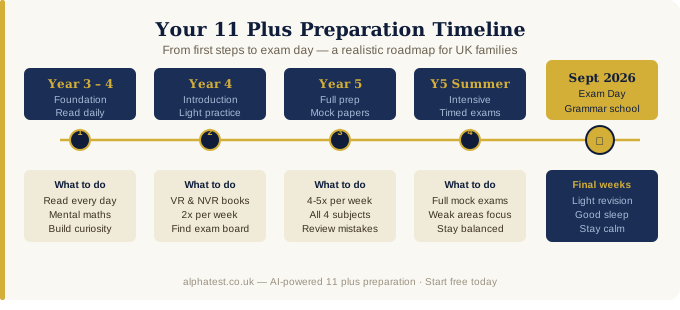
In Year 3 and early Year 4, the most valuable thing any parent can do is build strong reading habits and keep maths enjoyment alive. No formal 11+ preparation is needed at this stage. A child who reads every day for pleasure, who finds numbers interesting rather than threatening, and who has a broad and curious relationship with language is already building the foundations that the eleven plus rewards. This is not preparation — it is childhood. But it is the most important childhood investment a parent can make in their child's future exam performance.
From the start of Year 4, it is worth beginning to understand the 11 plus exam landscape. Research which exam board your target grammar schools use. Look at the format of past papers. Introduce verbal reasoning and non-verbal reasoning gently — as puzzles to solve rather than tests to pass — through one or two light sessions per week. The goal at this stage is familiarity and confidence, not intensity.
From Year 4 into early Year 5, increase practice to three or four sessions per week across all relevant subject areas. Begin identifying which areas come naturally and which need more work. Start introducing timed elements — not full exam timing, but an awareness of pace. This is also the right time to register with an adaptive platform like AlphaTest so that progress is tracked systematically and weak areas are identified before they become serious problems.
From January of Year 5, begin sitting full-length 11 plus mock exams under timed conditions. This is the single most important shift in the preparation programme. Sitting a full paper — all subjects, in sequence, under realistic time pressure, without help — reveals things that no amount of individual topic practice can. Children discover which subjects drain their concentration, how their accuracy changes as tiredness sets in, and whether their pace is sustainable across a full sitting. Every mock exam should be followed by a thorough debrief — every wrong answer examined, every near-miss understood, every pattern of error identified.
The summer holidays between Year 5 and Year 6 are the period most families use for the most intensive preparation. This is appropriate, provided balance is maintained. Five days per week of structured practice, with genuine rest days and plenty of physical activity, is sustainable. Seven days per week of back-to-back papers is not — and the anxiety and exhaustion it produces often undoes months of careful preparation.
From September of Year 6, the approach changes completely. The 11 plus exam dates 2026 in most regions fall in September or early October of Year 6, which means the exam arrives within weeks of the new school year beginning. In the final two to three weeks before the exam, shift away from new material entirely. Light consolidation only. The priority now is confidence, routine, good sleep, and a calm home environment. A child who goes into exam day well-rested, well-fed, and emotionally secure will perform closer to their true ability than one who crammed until midnight.
CEM vs GL Assessment: An Honest Comparison
The question of whether the CEM 11 plus or GL Assessment 11+ is harder comes up in every parent forum and every tutor conversation. The honest answer is that they are different in ways that matter more than simple difficulty ranking.
The GL Assessment 11+ rewards systematic, structured preparation. Because question types are published, papers are separated by subject, and past materials are commercially available, a motivated family with good resources can prepare effectively without professional tutoring. The 21 verbal reasoning question types can be learned and mastered methodically. GL Assessment 11+ past papers provide accurate practice in the real exam format. For families in Kent, Buckinghamshire, and Essex, this predictability is a genuine advantage.
The CEM 11 plus is harder to game. Because question types are not published and papers mix subjects unpredictably, intensive drilling of individual formats provides less advantage than it does for GL. This does not mean preparation is pointless — it means the preparation that works is different in character. Breadth of language exposure, mental maths fluency, and genuine calmness under pressure matter more than knowing 21 question types by heart. Children who read widely and think flexibly often find the CEM exam less intimidating than children who have prepared intensively through narrowly formatted question-type drilling.
For families whose target schools use GL Assessment, the availability of free 11+ practice papers, 11 plus past papers, and detailed question-type guides makes self-directed preparation genuinely viable. For CEM 11 plus families, the focus should be on building real skills rather than format familiarity. In both cases, timed practice and thorough mistake analysis are the most important habits.
The Role of AI in Modern 11 Plus Preparation
Traditional 11+ preparation meant paper workbooks, weekly tutor sessions, and practice papers marked by hand. The limitation of this model is that it treats every child the same — the same questions in the same order at the same difficulty level, regardless of what a particular child actually needs on a particular day.
AI-powered platforms have changed this. AlphaTest uses smart adaptive algorithms that analyse a child's responses in real time and adjust question difficulty, topic weighting, and subject balance accordingly. A child who is strong in 11 plus verbal reasoning but weak in 11+ non-verbal reasoning will automatically receive more NVR practice and less VR drilling — without any manual adjustment from a parent or tutor. A child who is progressing rapidly through maths will be served harder questions before they have time to get bored.
The practical effect is faster progress. Children using adaptive preparation spend their limited practice time on content that actually challenges them rather than repeating things they already know. This is particularly valuable in the final months before the exam, when every session counts and wasted practice time is a genuine cost.
The gamification layer — streaks, badges, achievements, and progress milestones — addresses one of the most persistent challenges in long-term 11 plus preparation: keeping a ten-year-old motivated over eighteen months of consistent daily practice. Parents across the UK using AlphaTest report that children who previously resisted exam practice began asking for extra sessions once the platform's reward system engaged their competitive instincts.
Parent dashboards showing accuracy trends, pace, topic-by-topic performance, and comparison against age-group benchmarks give families the information they need to make good decisions about where to focus next — without requiring hours of manual marking and analysis.
Best 11 Plus Books and Resources
The question of which are the best 11 plus books depends on your exam board and your child's specific weak areas. Here is an honest assessment of the most widely trusted resources among UK families and tutors.
For comprehensive coverage across all subjects and exam boards, the CGP 11+ range is the most widely used and consistently recommended. It covers verbal reasoning, non-verbal reasoning, English, and maths in separate volumes for both GL Assessment and CEM formats, is priced accessibly, and provides clear explanations alongside practice questions. Most families doing thorough 11+ preparation will use CGP books at some point in their programme.
Bond Assessment Papers offer age-graded practice in a familiar format used by many UK primary schools. The age 9-10 and 10-11 volumes are most relevant for 11+ preparation, and the separate answer books with working notes make self-marking practical for parents. Bond is particularly strong for GL Assessment 11+ verbal and non-verbal reasoning.
First Past the Post papers — produced by Athey Educational — are highly realistic mock papers in both GL Assessment and CEM formats. Many tutors rate them as the closest available match to real exam conditions. For families who have worked through CGP and Bond and need full mock paper practice in a realistic format, FPTP papers are the next step.
For mental arithmetic and maths fluency specifically, Schofield and Sims Mental Arithmetic books build calculation speed progressively from the simplest operations through to complex multi-step problems. Just five to ten minutes per day with these books over a year produces measurable improvements in arithmetic automaticity.
Free 11+ practice papers are available from several online resources including 11PluseHelp.co.uk, which offers free verbal and non-verbal reasoning practice questions with worked examples. These are useful for supplementary practice but should not replace structured exam-format papers for main preparation.
For adaptive, data-driven daily practice across all four subjects, AlphaTest complements all of the above resources — providing the kind of personalised, responsive preparation that paper-based resources alone cannot deliver.
11 Plus Exam Day: What Parents and Children Need to Know
Everything in the preparation builds towards a single morning. How that morning is managed matters more than most families realise.
The evening before the exam, the preparation is over. Nothing productive happens by cramming the night before an exam of this kind — the material is either embedded by now or it is not, and last-minute drilling does nothing except increase anxiety. A light meal the child enjoys, a relaxed evening, and an early bedtime are the right prescription. Eight to nine hours of sleep before an exam has a measurable positive effect on cognitive performance. One more verbal reasoning paper does not.
On the morning of the exam, a good breakfast that the child likes and finds easy to eat provides the blood sugar stability that concentration requires. Leave the house early enough that travel is relaxed. Arriving flustered and rushing at the gates is the worst possible way to begin an exam. Aim to arrive five to ten minutes before doors open so the child has time to settle.
In the final minutes before the exam begins, remind your child of the practical essentials: read every question carefully before answering, do not spend too long on any single question if it is not coming, move on and come back if needed, and check answers if time allows at the end. Then let them go. Your job outside the exam room is simply to appear calm — because children read their parents' emotional state with extraordinary accuracy, and a parent who looks anxious at the school gates transfers that anxiety directly.
After the exam, resist the urge to ask immediately which questions they found difficult or to compare answers with other children. This serves no useful purpose and can cause unnecessary distress. A treat and some genuine downtime — screen time, playing with friends, anything that has nothing to do with exams — is the right response. What is done is done. The preparation has been made. Whatever the result, your child sat an exam and did their best. That deserves recognition.
11 Plus Pass Marks: What Score Does Your Child Actually Need?
11 plus pass marks vary significantly by region, school, and year. They are not fixed thresholds — in most areas, they are determined each year based on the distribution of scores across all children who sat that year's test, the number of places available, and in some regions, catchment area weightings.
In Kent, the Kent Test uses a standardised score system. The pass mark in recent years has typically been around 320 to 332 out of 420, though this varies. Children who score above the pass mark are deemed selective and eligible for grammar school places. Children who score below can appeal.
In Buckinghamshire, the Buckinghamshire 11 plus uses a similar standardised score approach. The pass mark has historically been around 121, but again this is not a fixed figure and changes year on year.
For Trafford grammar schools, pass marks are set by each individual school and published annually. Competition in Trafford is very high given the number of high-quality grammar schools in the area and the large population of well-prepared children.
For the SET exam in Sutton, each school sets its own offer threshold based on the number of places available. Because five schools share the same test results, a child may score high enough for one Sutton grammar school but not for another in the same borough.
The most reliable source of 11 plus pass marks for any specific school is the school's own admissions page or its most recent admissions statistics, usually published on the school or local authority website. Understanding the realistic pass mark for your target schools — and comparing it honestly against your child's current mock exam performance — is essential context for managing expectations and making good preparation decisions.
If Your Child Does Not Pass the 11 Plus
This section is perhaps the most important in the entire guide.
The eleven plus is one test on one morning. It is not a measure of intelligence, character, creativity, resilience, emotional depth, or future success. It measures how well a child performs on a specific academic test on a specific day — nothing more and nothing less. Many of the most remarkable people in British public life did not attend grammar schools. Thousands of excellent state secondary schools exist outside the selective system, and a child who is genuinely happy in a school that suits how they learn will always outperform one who is anxious in a school they found barely accessible.
If your child does not achieve the required score, first check whether an appeal process exists in your area. In some regions — particularly where children fall just below the published pass mark — appeals succeed, particularly where there are mitigating circumstances such as illness on exam day or a recent significant life event. Your local consortium website will have appeal information.
If an appeal is not appropriate or does not succeed, turn your attention to researching the strong non-selective secondary schools in your area. In many competitive regions, the highest-performing non-selective schools have excellent outcomes, strong teaching, and supportive communities. A child who thrives in a non-selective school will always achieve more than one who struggles in a selective school that pushed them just a little beyond where they comfortably belonged.
Most importantly: prepare your child for all outcomes from the beginning. Children whose parents love and value them entirely independently of exam results experience less anxiety, perform closer to their potential, and recover more easily from disappointment. The goal of eleven plus preparation is to give your child the best possible chance on the day — not to tie their sense of self-worth to a single morning's performance.
Frequently Asked Questions
Many parents searching for how to prepare for 11 plus arrive with very specific questions. Here are the most common ones answered directly.
On the question of 11 plus exam dates 2026: most exams take place in September or early October of Year 6. Registration deadlines — which are separate and earlier — typically fall in the spring or early summer of Year 5. Missing a registration deadline means missing that year's sitting entirely, so checking your target school's website for exact dates and setting a calendar reminder is genuinely important.
On the question of whether 11 plus past papers from previous years are still useful: yes, absolutely. While exam boards occasionally adjust their format, the underlying skills tested remain consistent year on year. Working through a range of past papers — not just the most recent — builds familiarity with the range of question types and difficulty levels a child might encounter.
On the question of 11 plus vocabulary lists and 11+ spelling words: the most useful vocabulary practice focuses on words that appear in comprehension passages and verbal reasoning questions. High-frequency challenging words — words like eloquent, meticulous, resilient, diligent, calamity, alleviate, and articulate — reward the time spent learning them because they appear across multiple exam formats and subjects. Learning synonyms and antonyms for 11 plus vocabulary alongside definitions — knowing that resilient means tough or adaptable, and that its antonym is fragile — is particularly useful for verbal reasoning question types that involve word relationships.
On the question of online versus in-person 11 plus tuition: both work when done well. In-person tutors provide human relationship, real-time reading of a child's emotional state, and flexible response to how a session is going. Online platforms like AlphaTest provide adaptive difficulty, 24/7 availability, detailed analytics, and accessibility for families who cannot easily access or afford local 11 plus tutor near me options. For many families, a combination of both — one tutor session per week plus daily platform practice — produces the best outcomes.
Start Your Child's 11 Plus Journey with Confidence
The 11 plus exam is genuinely challenging. It demands skills that go well beyond the primary school curriculum, sustained concentration across multiple subjects under time pressure, and the emotional resilience to perform on a single high-stakes morning. But it is achievable — every year, thousands of children across England sit the eleven plus and earn grammar school places, not because they are exceptional in some innate way, but because they prepared thoughtfully, consistently, and with good support behind them.
The families who give their children the best chance are not necessarily the ones who start earliest or spend the most money. They are the ones who understand exactly what the exam requires, choose preparation resources matched to their specific exam board and child's needs, build consistent daily habits rather than relying on occasional intensive sessions, and keep the whole experience human — maintaining warmth, perspective, and genuine care for their child's wellbeing throughout the process.
AlphaTest exists to make that kind of smart, personalised preparation available to every UK family. Begin with a free assessment to find out exactly where your child stands across all four 11+ subjects, get a study plan tailored to your target grammar schools, and turn what can feel like an overwhelming process into a manageable, even enjoyable, daily routine.
Start your child's free 11 plus assessment at AlphaTest today →
This guide covers the 11 plus exam, eleven plus, 11+ preparation, grammar school entrance exam, CEM 11 plus, GL Assessment 11+, CSSE exam, SET exam, 11 plus verbal reasoning, 11+ non-verbal reasoning, 11 plus English comprehension, 11 plus maths practice, 11 plus past papers, free 11+ practice papers, 11 plus mock exams, 11 plus vocabulary list, 11+ spelling words, synonyms and antonyms for 11 plus, 11 plus pass marks, how to prepare for 11 plus, 11 plus exam dates 2026, best 11 plus books, Kent Test, Buckinghamshire 11 plus, Essex 11 plus, Trafford grammar schools, and 11 plus tutor near me. All AlphaTest links point to alphatest.co.uk. Updated for 2026–2027.
Ready to boost your child's 11+ preparation?
Try AlphaTest free — AI-powered practice, instant feedback, and gamified learning.
Start Free Trial