
11 Plus Pass Mark 2026: What Score Does Your Child Actually Need?
What is the 11 plus pass mark in 2026? Find out the exact scores needed for Kent, Buckinghamshire, Sutton SET exam, Essex CSSE and GL Assessment grammar schools across the UK.
Why the 11 Plus Pass Mark Is More Complicated Than Most Parents Expect
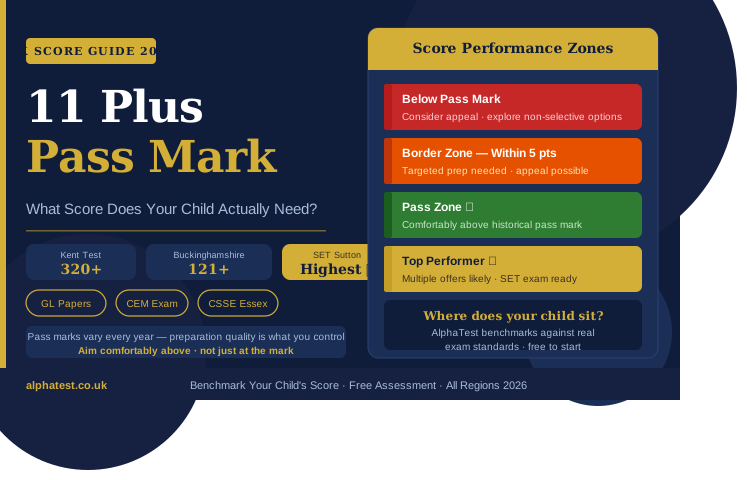
The 11 plus pass mark is the number every parent wants to know — and the number that is genuinely harder to pin down than it first appears. Unlike a school test where a fixed percentage always means a pass, the 11+ pass mark in most grammar school regions is not a fixed threshold. It moves. It is recalculated every single year based on the distribution of scores across all children who sat that year's exam, the number of places available in that year's intake, and in some regions, catchment area weightings that prioritise children who live closest to the school.
Understanding this is not a technicality. It has direct practical consequences for how families should interpret their child's mock exam scores during preparation. A child scoring 75 percent on a practice paper might be comfortably above the pass mark in one region and well below it in another. Without knowing the specific competitive context of your target schools, a raw score tells you very little about whether your child is genuinely on track.
This guide gives you the most accurate, up-to-date information on 11 plus pass marks across the major UK grammar school regions — and explains exactly how to use that information intelligently during preparation.
How 11 Plus Pass Marks Work in Practice
The mechanics behind 11 plus pass marks differ between the standardised scoring system used by most GL Assessment regions and the raw score systems used by some CEM and consortium-based exams. Understanding which system your target schools use is essential before drawing any conclusions from practice paper performance.
In regions using standardised scores — Kent, Buckinghamshire, and several others — a child's raw mark is converted into a standardised score that accounts for the child's age at the time of sitting. A child who sits the exam in September aged 10 years and 3 months is compared against all other children of that age, not against the full cohort. This age standardisation means a younger child in the cohort who scores the same raw mark as an older child will receive a higher standardised score. Parents whose children sit the exam relatively young compared to their peers have a meaningful statistical advantage built into the scoring system that is rarely discussed in 11 plus forums but is very real in practice.
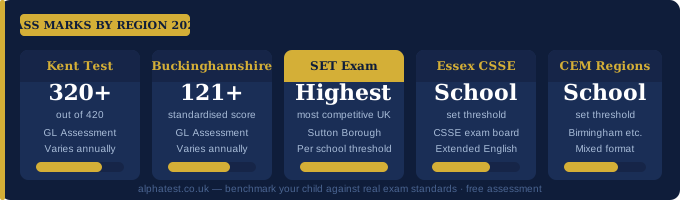
The Kent Test pass mark has historically fallen between 320 and 332 on a standardised scale out of 420, though this changes annually based on the number of selective places available and the overall performance of that year's cohort. A child who scores 318 one year might have passed the previous year. A child who scores 325 one year might fall just short the next. This is not a flaw in the system — it is the inevitable consequence of competitive selection — but it means that targeting a specific number during preparation is less useful than targeting a performance level that places a child comfortably above where the pass mark has historically fallen.
The Buckinghamshire 11 plus pass mark operates similarly, using a standardised score scale where the pass mark has typically been around 121. Buckinghamshire uses a two-stage assessment process, and children who pass the first stage proceed to a second sitting. The final offer decisions involve a combination of test score and school preference, making Buckinghamshire's selection process slightly more complex than single-sitting regions.
For the SET exam in Sutton, the pass mark concept works differently from GL Assessment regions. Each of the five Sutton grammar schools — Nonsuch, Wilson's, Wallington County, Wallington High School for Girls, and Sutton Grammar — sets its own offer threshold based on the number of places available and the scores achieved by that year's applicant pool. Because all five schools share the same test results, a child applying to multiple Sutton schools may find their score is sufficient for one school but not another in the same borough. The SET exam pass mark is consistently among the highest of any grammar school region in England — reflecting the extraordinary concentration of well-prepared children competing for a relatively limited number of places.
What to Do If Your Child's Mock Scores Are Near the Pass Mark
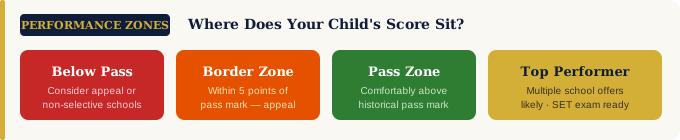
One of the most anxiety-inducing situations in 11 plus preparation is a child whose practice paper scores consistently land in the zone around the historical pass mark — not clearly below it, but not comfortably above it either. This is where preparation decisions matter most, and where most families need the clearest possible information rather than reassuring vagueness.
A child scoring consistently within five points of the historical 11 plus pass mark in their target region has genuine potential to achieve a grammar school place — but needs targeted improvement in specific areas rather than more of the same general preparation. The question to ask is not "how do we get a higher score overall?" but "which specific subjects and question types are costing the most marks?" A child who loses eight marks through weak verbal reasoning letter code questions and four marks through slow pace on the non-verbal reasoning paper has a very different remediation need from one who loses marks broadly across all four subjects.
This is precisely where AlphaTest's diagnostic assessment provides the most value. Rather than simply recording a total score, the platform analyses performance at the individual question-type level across all four 11+ subjects — identifying exactly which areas are costing marks and generating a targeted preparation plan that focuses subsequent practice on the highest-value improvements. A child in the border zone who spends six weeks targeting their three weakest question types with AlphaTest's adaptive practice will make more measurable progress than one who sits ten more general practice papers without analytical review.
The Appeal Process: What Families in the Border Zone Need to Know
Every major grammar school region in England has an appeals process for children who fall near the 11 plus pass mark. In Kent, children who score below the pass mark can appeal through the school's formal admissions appeals process. Appeals succeed most frequently when there are genuine mitigating circumstances — illness on exam day, a significant recent life event, or demonstrable evidence that the score does not reflect the child's true ability.
In Buckinghamshire, the two-stage process means children who narrowly miss the first stage threshold may have limited appeal options, but families should always check the specific admissions policy of each target school directly. Appeal policies are published annually and do change.
For SET exam schools in Sutton, the appeals process operates school by school. Because five schools share the same test results, a child who does not receive an offer from their first-choice school may still receive one from another Sutton grammar school with a slightly different threshold. Checking every available Sutton school's offer threshold before concluding that a SET exam score is insufficient is an important and often overlooked step.
The most reliable source for current appeal information is always your target school's own admissions page. Do not rely on 11 plus forum discussions about appeal outcomes from previous years — policies change, and the specific circumstances of your child's situation will always be different from the anecdotes shared by other families.
Using Mock Exam Performance to Benchmark Realistically
The most useful thing any family can do during 11+ preparation is develop a clear, honest picture of where their child's performance sits relative to the competitive field — not just relative to a published pass mark figure.
AlphaTest's parent dashboard benchmarks your child's performance against age-group standards across all four 11 plus subjects, giving you a realistic competitive picture rather than just a raw score. This benchmarking is updated continuously as your child's practice progresses, meaning you always have an accurate, current assessment of where they stand — not a snapshot from a single mock paper taken months ago.
Families who know exactly where their child stands, and exactly which areas need the most improvement, consistently make better preparation decisions than those navigating by raw scores alone. In a competitive process where the 11 plus pass mark shifts every year and varies dramatically between regions, genuine performance intelligence is the most valuable resource any family can have.
Get your child's free benchmark assessment at AlphaTest today →
Ready to boost your child's 11+ preparation?
Try AlphaTest free — AI-powered practice, instant feedback, and gamified learning.
Start Free Trial