
11 Plus Syllabus 2026: Complete Topic List for Every Exam Board
Complete 11 plus syllabus 2026 covering every topic and question type across GL Assessment, CEM, CSSE and SET exams. Verbal reasoning, non-verbal reasoning, English comprehension and maths — all in one guide.
What Is the 11 Plus Syllabus and Why Does It Matter So Much?
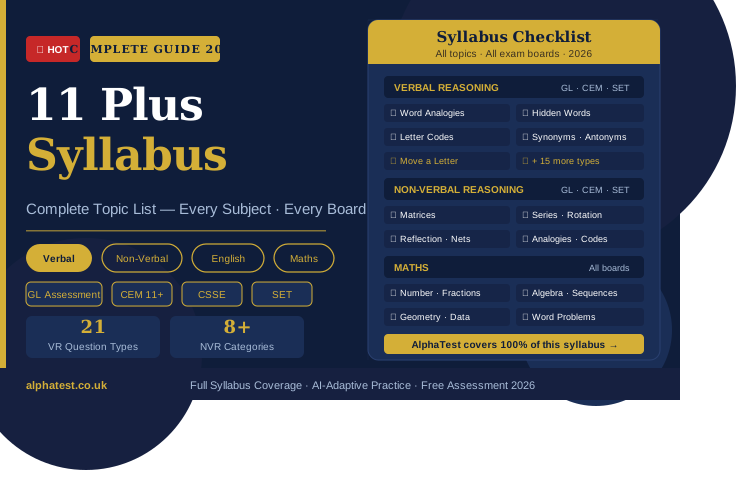
The 11 plus syllabus is the complete body of knowledge, skills, and question types that your child will be assessed on in the grammar school entrance exam. Understanding it in full — not just broadly, but in precise detail — is the single most important step in building an effective preparation plan for 2026.
The reason most families underperform in 11+ preparation is not lack of effort. It is lack of direction. They buy practice papers, sit their child in front of them, and hope that repetition produces improvement. It does not — not reliably, and not efficiently. The families who prepare most effectively are the ones who know exactly what the 11 plus syllabus 2026 covers, which topics carry the most marks, and which question types their child has not yet encountered.
This guide gives you the complete 11 plus topic list for every major UK exam board — GL Assessment 11+, CEM 11 plus, CSSE exam, and SET exam — broken down subject by subject, question type by question type. Use it as the master reference document for your child's entire preparation programme.
The Complete 11 Plus Verbal Reasoning Syllabus
11 plus verbal reasoning is the most distinctively exam-specific subject in the entire 11+ syllabus. It does not appear in the primary school curriculum, it is not taught in Year 5 or Year 6 lessons, and it bears almost no resemblance to anything a child encounters in day-to-day school life. This is precisely why it demands the most specific, structured preparation of any subject on the 11 plus topic list.
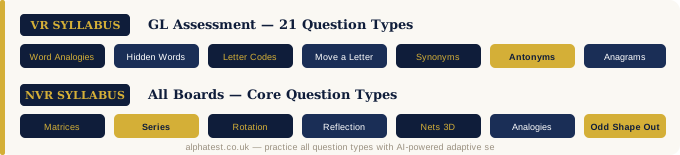
For the GL Assessment 11+, verbal reasoning is assessed through 21 published question types. Every child targeting a GL Assessment grammar school must know all 21 of these types by name, recognise each one on sight, and be able to apply the correct solving method reliably under timed conditions. The complete GL Assessment verbal reasoning syllabus includes word analogies, hidden words, letter sequences, alphabetical codes, word connections, move-a-letter, compound words, anagrams, odd-one-out by meaning, synonyms, antonyms, word patterns, double meanings, related words, missing three-letter words, word number codes, letter-number codes, new word from two words, word ladders, select the odd one out, and complete the sum.
For the CEM 11 plus syllabus, verbal reasoning question types are not officially published. CEM blends verbal reasoning with comprehension tasks within a single mixed paper, switching between question types without warning. The preparation focus for CEM verbal reasoning is therefore breadth rather than type-specific mastery — building genuine language fluency, strong vocabulary, and the mental agility to switch between different types of language task at speed.
The vocabulary dimension of the 11 plus verbal reasoning syllabus underpins performance across every question type and every exam board. Words appearing regularly in 11+ verbal reasoning papers include: abundant, alleviate, articulate, audacious, belligerent, benevolent, calamity, diligent, eloquent, formidable, indignant, meticulous, melancholy, resilient, serene, tenacious, versatile, and vivacious. Children who encounter these words for the first time in the exam room are at an irreversible disadvantage compared to those who have been building vocabulary systematically for twelve to eighteen months.
AlphaTest's Verbal Reasoning module covers all 21 GL Assessment question types and CEM-style mixed verbal practice in one adaptive platform — adjusting difficulty in real time based on which specific types your child finds most challenging.
The Complete 11 Plus Non-Verbal Reasoning Syllabus
11 plus non-verbal reasoning — commonly written as 11+ NVR — assesses logical thinking through shapes, patterns, and visual sequences without words or numbers. It appears in the GL Assessment 11+, CEM 11 plus, and SET exam syllabuses, but plays a minimal role in the CSSE exam.
The complete 11 plus non-verbal reasoning syllabus covers the following question types across GL Assessment and CEM formats. Matrices require children to identify the missing shape in a two-by-two or three-by-three grid by identifying the rule that governs each row and column simultaneously. Series questions present a sequence of shapes and ask which comes next. Analogy questions present a pair of related shapes and ask which shape completes a parallel relationship. Reflection questions test whether children can identify the correct mirror image of a shape across a vertical or horizontal axis. Rotation questions require children to identify what a shape looks like after being turned by a specified angle. Nets questions present a flat net and ask which three-dimensional shape it would produce when folded. Code questions use shapes as symbols within a coding system. Odd-shape-out questions require children to identify which shape in a group does not share the same property as the others.
The key insight about non-verbal reasoning 11 plus preparation is that every question type has a finite set of underlying rules. Once a child understands that matrix questions always have one consistent rule applying across every row and every column, and that rotation questions always preserve size and shape while changing orientation, the apparent complexity of NVR dissolves into a manageable set of logical operations. This is a subject that responds exceptionally well to structured, type-by-type preparation.
The Complete 11 Plus English Comprehension Syllabus
11 plus English comprehension appears in the 11+ syllabus of every major exam board, though the format in which it is assessed differs significantly between them. Understanding these format differences is essential for targeted preparation.
For GL Assessment and SET exam English, comprehension is assessed through a passage of text — fiction, non-fiction, or poetry — followed by multiple-choice questions. The question types in the GL Assessment English syllabus cover literal retrieval, vocabulary in context, inference and deduction, author's technique, literary device identification, summary, and character or theme analysis.
For the CEM 11 plus, comprehension is embedded within the verbal reasoning paper rather than presented as a separate subject. Passages are shorter and the questions move quickly — rewarding children who can read, understand, and respond at pace.
For the CSSE exam, the English syllabus is the most demanding of all four boards. It includes extended reading comprehension with written responses — not multiple choice — plus a creative or descriptive writing task assessed on structure, vocabulary, sentence variety, and engagement. Children preparing for the CSSE English syllabus must practise written composition regularly from Year 4 onwards.
The literary devices that appear most frequently across all 11+ English syllabuses include simile, metaphor, personification, alliteration, onomatopoeia, imagery, hyperbole, and oxymoron. Children must be able to identify these devices on sight and explain the effect they create on the reader — not merely name them.
The Complete 11 Plus Maths Syllabus
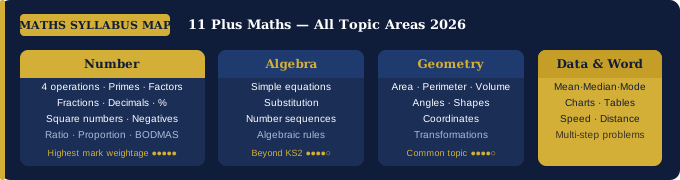
The 11 plus maths syllabus extends beyond the standard KS2 curriculum in ways that consistently catch underprepared children off guard. The complete 11+ maths topic list for 2026 covers the following areas across all exam boards.
Number and calculation topics include the four operations with large numbers and decimals, prime numbers, factors and multiples, highest common factor and lowest common multiple, square numbers and square roots, negative numbers, and order of operations including brackets. Fractions, decimals, and percentages cover simplification, equivalence, conversion, all four operations with fractions, percentage of an amount, percentage increase and decrease, and reverse percentage calculations.
Ratio and algebra topics include sharing in a given ratio, simplifying ratios, direct and inverse proportion, simple equation solving, substitution into algebraic expressions, and generating and continuing sequences including algebraic rules. Geometry covers area and perimeter of rectangles, triangles, parallelograms, trapeziums, and circles, volume of cuboids and prisms, angles on a line, in triangles, in quadrilaterals, in parallel lines, and properties of two-dimensional and three-dimensional shapes. Coordinates in all four quadrants and transformations including translation, reflection, and rotation also appear across multiple exam boards.
Data handling topics in the 11 plus maths syllabus include reading and interpreting tables, bar charts, pictograms, line graphs, and pie charts, calculating mean, median, mode, and range, and solving problems using data from multiple sources. Speed, distance, and time problems — using the formula triangle — appear regularly in the CSSE maths and SET exam maths papers at the higher difficulty level and must be specifically practised.
How the 11 Plus Syllabus Differs Between Exam Boards
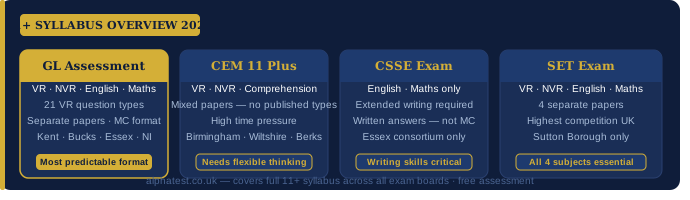
Understanding the 11 plus syllabus in the abstract is useful. Understanding precisely how it differs between the four major exam boards is essential. The following differences determine exactly which topics deserve the most preparation time for your child specifically.
The GL Assessment 11+ syllabus is the most clearly defined of all four boards. With 21 published verbal reasoning question types, separate papers for each subject, and past papers commercially available, it rewards systematic preparation through the entire topic list. Children targeting GL Assessment grammar schools should work through every one of the 21 VR types, every NVR category, and every maths topic on the list above — marking each as they achieve consistent accuracy — before moving into full mock exam practice.
The CEM 11 plus syllabus is deliberately less defined. Because CEM publishes no official question types, preparation must focus on genuine skill development across broad verbal and numerical domains rather than format familiarity. The verbal and comprehension skills that underpin CEM 11 plus performance are the same ones on the topic list above — the difference is that they are assessed in a mixed, unpredictable format rather than cleanly separated papers.
The CSSE exam syllabus is unique in its requirement for extended written English. No other major exam board asks children to produce a significant piece of creative or descriptive writing under timed exam conditions. This single distinction means that children targeting Essex grammar schools must add creative writing practice to their preparation programme from Year 4 — a requirement that does not apply to any other exam board.
The SET exam syllabus covers all four subjects at a high standard, with competition levels among the most demanding in England. All topics on the complete 11 plus topic list above are relevant for SET preparation, and none can be treated as a lower priority.
Using the 11 Plus Syllabus to Build Your Preparation Plan
The most effective way to use this complete 11 plus syllabus 2026 is as a tracking document throughout your child's preparation. Work through each subject area systematically, ticking off question types and topics as your child achieves consistent accuracy — say, eight out of ten correct in timed conditions. Any topic not yet ticked becomes the priority for the following week's sessions.
This approach — sometimes called mastery-based preparation — is fundamentally more efficient than sitting practice papers randomly and hoping all topics get covered. It ensures no part of the 11+ syllabus is accidentally neglected, it produces a clear record of progress that reduces parental anxiety, and it makes tutor sessions — where families use them — far more targeted and valuable.
AlphaTest tracks progress across every topic on the 11 plus syllabus automatically, updating accuracy metrics after every session and highlighting which areas are approaching exam-ready standard and which still need focused attention. The parent dashboard gives families complete visibility of syllabus coverage in real time — so preparation decisions are always driven by data rather than guesswork.
Ready to boost your child's 11+ preparation?
Try AlphaTest free — AI-powered practice, instant feedback, and gamified learning.
Start Free Trial