
11 Plus Exams: Frequently Asked Questions — Complete Parent Guide 2026
Complete FAQ guide for 11 plus exams 2026. Answers to 25+ common questions parents ask about preparation, exam dates, registration, pass marks, tutors, apps and what happens after results.
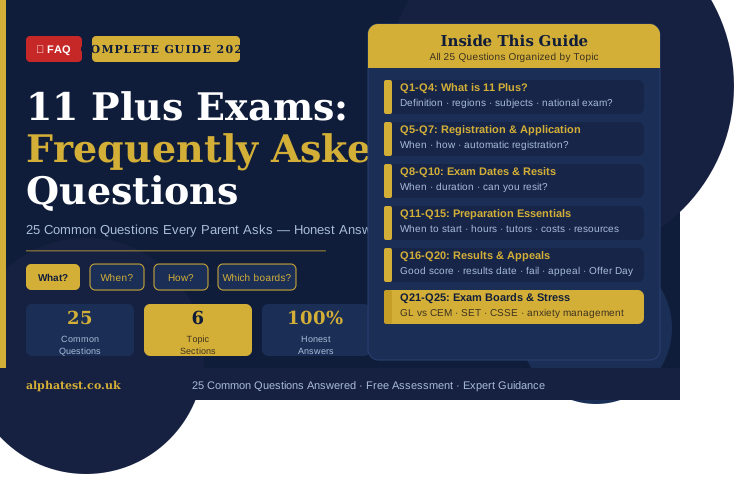
The 25 Questions Every 11 Plus Parent Asks (And Actually Needs Answered)
The 11 plus exam generates endless parent questions — and most of the answers floating around on 11 plus forums are either incomplete, outdated, or regionally specific without being clear about it. This guide answers the 25 questions we hear most frequently from UK families preparing for 11+ exams in 2026, with straight answers rather than vague reassurance.
SECTION 1 — WHAT IS THE 11 PLUS?
Q1: What exactly is the 11 plus exam?
The 11 plus exam (also written as 11+ or eleven plus) is a selective entrance test taken by children in their final year of primary school (Year 6, typically age 10-11) to determine admission to grammar schools. It assesses whether a child has the academic capability to succeed at grammar school level.
The exam is not a national test — different regions of England use different exam boards (GL Assessment, CEM, CSSE, SET, ISEB) and different formats. There is no national pass mark. Each region and school sets its own threshold. The 11 plus syllabus broadly aligns with the UK National Curriculum Key Stage 2 (Years 4-6), but with question types and difficulty pitched higher than typical school standard. Similarweb
Q2: Which regions have grammar schools and 11 plus exams?
Approximately 20% of England has selective secondary education. Major grammar school regions include Kent, Buckinghamshire, Essex, Sutton (London), Slough, Berkshire, Wiltshire, Birmingham, Shropshire, Lincolnshire, and several others. Northern Ireland has all-ability grammar schools. Scotland does not use the 11 plus system.
If you are uncertain whether your area has grammar schools, check your local authority website directly.
Q3: What are the four subjects tested in the 11 plus?
Most 11+ exams test four subjects: English (reading comprehension, grammar, punctuation, spelling, vocabulary, and sometimes creative writing), Mathematics (number, fractions, algebra, geometry, measurement, statistics and word problems), Verbal Reasoning (word puzzles, codes, analogies and logic) and Non-Verbal Reasoning (visual patterns, sequences, rotations and spatial reasoning). Similarweb
Some exam boards (particularly CSSE) test only English and Maths. Check your specific exam board's requirements.
Q4: Is the 11 plus a national test?
No. The 11 plus is not a national exam in the UK. It is administered by regional exam boards, local authorities, and individual schools. There is no national pass mark, no national curriculum, and no national statistics on pass rates. Each region sets its own threshold, and each grammar school may set slightly different offers based on the applicant pool that year.
SECTION 2 — WHEN AND HOW DO I REGISTER?
Q5: When does 11 plus registration open in 2026?
Registration timing varies by region. Most regions open in April-May 2026, with deadlines closing between May and July 2026. Some CEM regions open as early as March. Check your specific region's dates immediately — missing the registration deadline means your child cannot sit the exam that year.
Q6: What is the difference between registration and application?
Registration means signing your child up to sit the exam itself. Application means applying for a school place through your local authority's Common Application Form (CAF), which has a national deadline of 31 October 2026.
Both are required. Registration does not automatically submit your school place application.
Q7: Will my child's school automatically register them?
For children at state primary schools in selective regions, schools often automatically register children for the exam. However, you should confirm this with your child's school — do not assume. Out-of-county and independent school children must register themselves.
SECTION 3 — EXAM DATES AND TIMING
Q8: When is the 11 plus exam held?
Most 11 plus exams in the UK are held in September 2026, usually within the first two to three weeks. Exact dates vary by region and exam board. Check your specific school or local authority website for confirmed 2026 dates. Eleven Ace
Q9: How long does the 11 plus exam take?
Total exam time is typically 2.5 to 3 hours across all four subjects, usually sat in multiple sittings (one paper per day or spread across two days) rather than all at once. Actual sitting time is usually 45 minutes per paper with breaks between.
Q10: Can my child resit the 11 plus if they don't pass?
Yes, but not immediately. If your child does not achieve a grammar school place in Year 6, they can resit the exam the following year as an external candidate. However, this delays grammar school entry by one year. Some regions offer appeal processes if the score is very close to the pass mark.
SECTION 4 — PREPARATION
Q11: When should I start 11 plus preparation?
There is no single "correct" start time — it depends on your target region, your child's current ability, and which exam board you are preparing for. Children targeting highly competitive regions (Sutton SET exam, for example) should start in Year 4. Most families start in early Year 5. Starting in Year 6 is possible but leaves limited time for thorough preparation.
Q12: How much time should my child spend practising 11 plus?
Most tutors recommend 60-90 minutes per day during the final 6 months of preparation. This typically breaks down as: 30 minutes of focused topic practice, 30 minutes of timed past papers or practice questions, and 15-30 minutes of mental arithmetic or vocabulary building. Younger children (Year 4) benefit from shorter, more frequent sessions (20-30 minutes daily).
Q13: Should I hire a tutor?
Tutors are helpful but not essential. Parents across the UK using AlphaTest report that children who previously resisted exam practice began asking for extra sessions once the platform's reward system engaged their competitive instincts. The most effective model for most families combines one weekly tutor session (for human relationship and expert explanation of difficult concepts) with daily adaptive digital practice like AlphaTest. Tutors alone cannot provide the daily reinforcement that produces measurable improvement. Pakistan News Today
Q14: How much should 11 plus tutoring cost?
Online tutoring ranges from £15-£50+ per hour depending on the tutor's experience and the platform. Local independent tutors typically charge £25-£40 per hour. Premium platforms like The Profs charge £45-£70 per hour. Free adaptive apps like AlphaTest's free assessment provide diagnostic information that helps families make smart tutor choices rather than hiring blindly.
Q15: What are the best 11 plus resources?
CGP workbooks are the most widely recommended for topic learning. Bond Assessment Papers are the most trusted for practice papers. Schofield & Sims Mental Arithmetic books are essential for building calculation speed. AlphaTest provides AI-adaptive daily practice that identifies exactly which topics need focus. Most effective families use a combination rather than relying on a single resource.
SECTION 5 — THE EXAM AND RESULTS
Q16: What is a good score on the 11 plus?
This depends entirely on your target school's threshold that year. "Good" means above your target school's pass mark. Average scores typically range from 280-320 (out of 420 for GL Assessment papers) depending on the region and cohort difficulty. The only meaningful measure is whether the score exceeds your specific target school's offer threshold.
Q17: When do 11 plus results come out?
Results are typically released in mid-October 2026, about 4-6 weeks after the exam. Check your specific exam board or local authority website for confirmed dates. Results go to the child's school rather than directly to parents in most regions.
Q18: What happens if my child doesn't pass?
If your child scores below the pass mark, they do not receive a grammar school place. Options include: appealing if the score is very close to the threshold, applying to non-selective secondary schools through the standard CAF process, or preparing to resit the exam the following year as an external candidate. Many children thrive in excellent non-selective secondaries.
Q19: Can I appeal the 11 plus result?
Most local authorities and schools have an appeals process, but appeals are typically only successful if there are exceptional circumstances (illness on exam day, for example) or if the scoring process was demonstrably flawed. Appealing because you believe your child should have passed is not grounds for successful appeal.
Q20: What is National Offer Day?
National Offer Day is 1 March 2027 when all secondary school places are allocated across England. This is when families learn which school their child has been offered, based on the 11 plus result (if applicable) and their CAF preferences.
SECTION 6 — SPECIFIC EXAM BOARDS
Q21: What is the difference between GL Assessment and CEM?
GL Assessment publishes 21 specific verbal reasoning question types, separates papers by subject, and uses multiple-choice format. It is more predictable and benefits from specific format familiarisation.
CEM does not publish question types, blends verbal reasoning with comprehension, and uses mixed-format papers. It rewards genuine language fluency over format familiarity.
Both are legitimate paths to grammar school entry. The choice depends on which exam your target schools use.
Q22: What is the SET exam in Sutton?
The SET exam is used by five Sutton Borough grammar schools simultaneously. A single exam sitting determines offers from all five schools. The SET exam is known as the most competitive in England — applicants are typically highly prepared children from selective regions.
Q23: What is the CSSE exam in Essex?
The CSSE exam is used by ten Essex grammar schools. Unlike GL Assessment and CEM, CSSE requires written answers rather than multiple choice, and includes a creative writing task in the English paper. Preparation must include substantial written work practice.
SECTION 7 — STRESS AND SUPPORT
Q24: Is my child too stressed about the 11 plus?
Some anxiety is normal and even helpful for motivation. Excessive stress — sleep disruption, physical symptoms, school refusal, or expressing fear repeatedly — is not. If your child shows signs of severe anxiety, prioritise their mental health over exam performance. A well-adjusted child in a good non-selective school succeeds. A highly stressed child in any school struggles.
Q25: What if my child doesn't want to do the 11 plus?
Your child's willingness to participate matters. If they are deeply resistant, explore why. Is it exam anxiety? Peer pressure? Genuine preference for a different school? Forcing a reluctant child into selective school entry rarely produces good outcomes. The best outcome is a child who wants to attend and feels genuinely prepared.
The Real Truth About 11 Plus Preparation
The single most important factor in 11 plus exam success is not which tutor you hire, which books you buy, or which past papers you sit. It is consistency. A child who practises 45 minutes daily for 12 months outperforms one who practises 3 hours daily for 3 months. A child whose parent celebrates small progress wins psychologically. A child who understands the exam is not a measure of their worth succeeds regardless of the score.
Ready to boost your child's 11+ preparation?
Try AlphaTest free — AI-powered practice, instant feedback, and gamified learning.
Start Free Trial