
11 Plus Maths Topics: What Is Tested and How to Master Every One in 2026
Complete guide to 11 plus maths topics tested in UK grammar school entrance exams 2026. Covers GL Assessment, CEM, CSSE and SET maths — with expert tips, topic breakdowns and proven practice strategies.
Why 11 Plus Maths Is Different From Everything Your Child Learns at School
There is a widely held assumption among parents beginning 11 plus preparation that maths will be the subject their child finds most straightforward. After all, children have been doing maths at school since Year 1. They know their numbers. They have covered fractions and percentages. Surely the 11 plus maths paper is just school maths under a time limit?
This assumption is one of the most costly mistakes families make in grammar school entrance exam preparation. The 11 plus maths paper is not school maths. It is school maths extended significantly beyond what Year 5 and Year 6 lessons typically cover, presented in unfamiliar problem formats, assessed under tight time pressure, and designed specifically to differentiate between children who have merely followed the school curriculum and those who have genuinely mastered mathematical thinking.
The children who perform best in 11+ maths are not necessarily the ones who are best at school maths. They are the ones who have learned to think mathematically — to read a problem carefully, identify what is actually being asked, select the correct method, apply it accurately, and do all of this quickly enough to complete every question before time runs out. These are skills that must be built deliberately. They do not emerge from school lessons alone, and they do not emerge from simply sitting practice papers without targeted preparation behind them.
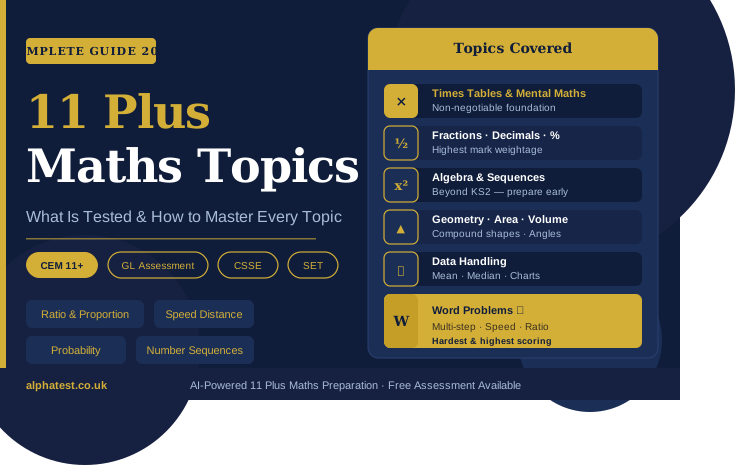
This guide covers every major 11 plus maths topic tested across the four main UK exam boards — GL Assessment 11+, CEM 11 plus, CSSE exam, and SET exam — with specific preparation advice for each area. Work through it systematically, and use it as the foundation of a preparation plan that builds genuine mathematical confidence rather than surface-level familiarity with exam formats.
V
visualize
V
visualize show_widget
The Non-Negotiable Foundation: Times Tables and Mental Arithmetic
Before any other 11 plus maths topic is worth discussing, one foundational requirement must be met completely: times tables must be automatic up to 12 × 12, and basic mental arithmetic must be fast and reliable. This is not a suggestion. It is a prerequisite. Every other topic in the 11+ maths paper — fractions, ratio, algebra, area, word problems — relies on the ability to perform basic multiplication and division quickly and without conscious effort.
A child who pauses to work out 8 × 7 under exam conditions has already lost time that cannot be recovered. Over the course of a 45-minute 11 plus maths paper, dozens of small calculations feed into larger multi-step problems. If each of those small calculations costs two or three extra seconds because times tables are not fully automatic, the cumulative time loss can easily mean five or six questions left unanswered at the end of the paper. Those unanswered questions represent marks that no amount of mathematical knowledge can recover.
The solution is straightforward but requires consistency. Five minutes of daily mental maths drill — run as a game rather than a test, kept light and positive — builds automaticity progressively over a period of months. By the time the grammar school entrance exam arrives, a child who has drilled daily for six months can retrieve any times table answer in under one second. That speed compounds into a meaningful time advantage across the full paper.
Mental arithmetic extends beyond times tables. Children should be comfortable dividing by single-digit numbers mentally, doubling and halving two and three-digit numbers quickly, rounding to the nearest ten, hundred, and thousand without written working, and adding and subtracting mentally across place value boundaries. These skills form the invisible scaffolding that holds every other 11 plus maths topic together.
AlphaTest's maths module builds mental arithmetic fluency through daily adaptive practice, tracking speed and accuracy separately so parents can see exactly when automaticity has been achieved and when a child is still computing rather than recalling.
Number: Fractions, Decimals, Percentages and Ratio
Number work — fractions, decimals, percentages, and ratio — accounts for a substantial proportion of marks in every 11 plus maths paper across all four exam boards. These topics are interconnected in ways that many children do not fully grasp until they are specifically taught the relationships between them, and that lack of interconnected understanding is one of the most common sources of avoidable errors in the GL Assessment maths and CEM 11 plus maths papers.
Fractions must be understood at multiple levels. Children need to simplify fractions, find equivalent fractions, add and subtract fractions with different denominators, multiply and divide fractions, and convert between fractions, decimals, and percentages fluently. The conversion relationships — that one quarter equals 0.25 equals 25 percent, that one third equals 0.333 equals 33.3 percent — should be known automatically for the most common fractions, because having to calculate these conversions during the exam wastes time that more challenging questions demand.
Percentages in 11+ maths go beyond simple percentage calculations. Children must find a percentage of an amount, find what percentage one number is of another, calculate percentage increase and decrease, and work backwards from a percentage to find an original value. The reverse percentage problem — if 80 percent of a number is 64, what is the number? — is one of the most commonly mishandled question types in 11 plus maths past papers, because children who have only practised forward percentage calculations have never learned the reverse method.
Ratio and proportion questions require children to share quantities in a given ratio, simplify ratios, find missing values in proportion problems, and apply ratio thinking to real-world contexts involving recipes, distances, and scaling. These questions frequently appear in multi-step word problem format, which means a child must first identify that ratio is the relevant concept before applying the method — a recognition skill that only develops through exposure to a wide variety of question contexts.
Algebra: The Topic Most Primary Schools Barely Touch
Algebra is the 11 plus maths topic that produces the greatest gap between children who have prepared specifically for the grammar school entrance exam and those who have relied on school lessons alone. Most primary schools introduce algebraic concepts only briefly and at a surface level. The 11+ maths paper tests algebra at a depth that feels genuinely unfamiliar to many Year 6 children encountering it for the first time under exam conditions.
At its most fundamental level, 11 plus algebra requires children to find the value of an unknown variable — solving equations like 3x + 7 = 22 or finding the missing number in a sequence. These problems are accessible once the method is understood, but the understanding must be built explicitly. A child who has never been taught to treat an equation as a balance — what you do to one side you must do to the other — cannot reliably solve algebraic problems under time pressure regardless of how mathematically capable they are.
Beyond simple equation solving, algebra in the 11+ maths paper extends into substitution — finding the value of an expression when variable values are given — and into number sequences, where children must identify the rule governing a sequence and use it to find missing terms. Arithmetic sequences, geometric sequences, and sequences with alternating rules all appear in 11 plus maths past papers across different exam boards. The key preparation strategy is to always find the rule before finding the answer — children who try to spot the next term by intuition rather than identifying the underlying rule consistently make errors on more complex sequences.
Geometry: Shape, Space and Measurement
The geometry section of the 11 plus maths paper covers area and perimeter, volume, angles, properties of shapes, and coordinate geometry. This is an area where many children lose marks not because they do not know the formulas, but because they apply them incorrectly in unfamiliar contexts.
Area and perimeter questions in the GL Assessment maths and CEM 11 plus maths papers frequently involve compound shapes — shapes made up of two or more simpler shapes combined or with sections removed. A child who knows the formula for the area of a rectangle but has never practised applying it to an L-shaped or T-shaped compound figure will struggle. The preparation strategy here is to practise compound shape problems specifically, developing the habit of breaking complex shapes into familiar components before calculating.
Volume questions extend from simple cuboids into triangular prisms and other three-dimensional shapes. The formula for the volume of a prism — cross-sectional area multiplied by length — must be understood conceptually, not just memorised, because exam questions often present the cross-section in an unfamiliar orientation or require the child to find the cross-sectional area before calculating volume.
Angles questions require knowledge of angle rules — angles on a straight line sum to 180 degrees, angles in a triangle sum to 180 degrees, angles in a quadrilateral sum to 360 degrees, vertically opposite angles are equal, corresponding and alternate angles in parallel lines — and the ability to apply multiple rules in sequence within a single problem. Multi-step angles problems, where finding one unknown angle enables the calculation of another, are a consistent feature of CSSE maths and SET exam maths papers at the higher difficulty level.
Data Handling: The Quiet Mark-Winner
Data handling is one of the most underestimated 11 plus maths topics in most preparation programmes. It sits quietly at the end of many topic lists, rarely generating the same level of focused practice as fractions or algebra, yet it accounts for a meaningful number of marks in the GL Assessment 11+, CEM 11 plus, and SET exam maths papers.
Children need to read and interpret bar charts, pictograms, line graphs, pie charts, and frequency tables accurately. They need to calculate mean, median, mode, and range from data sets of varying sizes, and they need to understand the difference between these measures well enough to identify which is most appropriate in a given context. Mean calculations involving large numbers — finding the mean of eight values that sum to several hundred — require both method knowledge and calculation accuracy under time pressure.
The most common error in 11 plus maths data handling questions is misreading scales on graphs and charts. A bar chart with a y-axis that increases in intervals of four rather than one, or a pie chart where sections must be estimated from angle measurements, requires careful reading that children who have only practised straightforward data questions are not prepared for. Exposure to a wide variety of chart types and scales during preparation is the specific remedy.
Word Problems: Where Prepared Children Separate From Unprepared Ones
Multi-step word problems are the highest-difficulty 11+ maths question type, and the one where the gap between prepared and unprepared children is most visible. These questions do not present mathematical operations directly. They describe a scenario — a purchase, a journey, a recipe, a construction project — and require the child to extract the relevant mathematical information, identify the sequence of operations needed, execute each calculation accurately, and produce a final answer that correctly addresses the question asked.
The most important preparation habit for word problems is reading every question twice before beginning any calculation. The number of marks lost in 11 plus maths past papers because children misread a question — calculating the wrong quantity, using the wrong unit, answering a slightly different question from the one asked — is extraordinary. A child who reads carefully and calculates slowly will consistently outscore one who reads once and calculates quickly.
The second most important habit is showing working clearly even when it is not explicitly required. Working serves two purposes. First, it allows the child to check their own method by reviewing the steps rather than the final answer. Second, in exams where method marks are available — as they are in the CSSE maths paper — clearly shown working earns marks even when the final answer is wrong.
Practice word problems from a wide variety of contexts. Speed, distance, and time problems require comfort with the formula triangle. Proportion problems that involve scaling recipes or costs require ratio thinking. Problems involving profit, loss, and percentage change require percentage mastery in applied contexts. The child who has seen fifty different word problem scenarios will recognise the underlying mathematical structure of a new one far faster than the child who has only practised topic questions in isolation.
How to Build an Effective 11 Plus Maths Practice Routine
Understanding the 11 plus maths topics is only half the preparation task. The other half is building a practice routine that develops the skills those topics demand — accuracy, speed, method knowledge, and problem-solving fluency — progressively over a sustained preparation period.
The most effective routine for most families follows a simple three-part structure. Daily mental maths — five minutes every morning, before school if possible — maintains arithmetic automaticity and keeps calculation speed sharp throughout the preparation period. Weekly topic sessions — one or two focused sessions per week targeting a specific 11 plus maths topic — build method knowledge and deepen understanding of each area in turn. Monthly full mock papers — a complete 11 plus maths paper sat under strict timed conditions — develop exam-condition pace and reveal which topics still need attention under pressure.
The debrief after every mock paper is where the most learning happens. Every wrong answer should be categorised: was it a method error, a calculation error, a misread question, or a topic the child has not yet covered? Each category requires a different response in the following week's practice sessions. Method errors indicate that the relevant topic needs to be re-taught from the approach rather than simply practised again. Calculation errors indicate that mental arithmetic automaticity needs more daily drilling. Misread questions indicate that the pre-calculation reading habit needs reinforcing. Uncovered topics indicate a gap in the preparation programme that must be addressed before the next mock.
AlphaTest's maths module adapts difficulty in real time across every 11 plus maths topic, provides immediate detailed feedback on every answer, and tracks accuracy and speed trends by topic over time — giving parents the data they need to make smart decisions about where preparation time is most needed. The parent dashboard makes it straightforward to see which topics are approaching exam-ready standard and which still need focused attention, without requiring hours of manual paper marking and analysis.
The Mindset That Makes the Difference on 11 Plus Maths Exam Day
Every 11 plus maths topic in this guide can be taught, practised, and mastered by a Year 5 or Year 6 child with the right preparation. The difference between children who walk out of the exam room feeling confident and those who do not is rarely a difference in mathematical ability. It is a difference in preparation quality, practice consistency, and the habits built over months of deliberate work.
Start with times tables. Build mental arithmetic. Work through number topics systematically. Introduce algebra and geometry progressively. Practise word problems extensively. Sit mock papers under timed conditions. Debrief every wrong answer. And maintain the daily reading and vocabulary habits that ensure your child can read every maths question accurately — because in a paper full of word problems, mathematical ability and reading comprehension are inseparable partners.
Ready to boost your child's 11+ preparation?
Try AlphaTest free — AI-powered practice, instant feedback, and gamified learning.
Start Free Trial