
11 Plus English Comprehension: Tips and Tricks to Score Higher in 2026
Master 11 plus English comprehension with expert tips for 2026. Covers GL Assessment, CEM, CSSE and SET exam comprehension skills — inference, vocabulary, literary devices and creative writing.
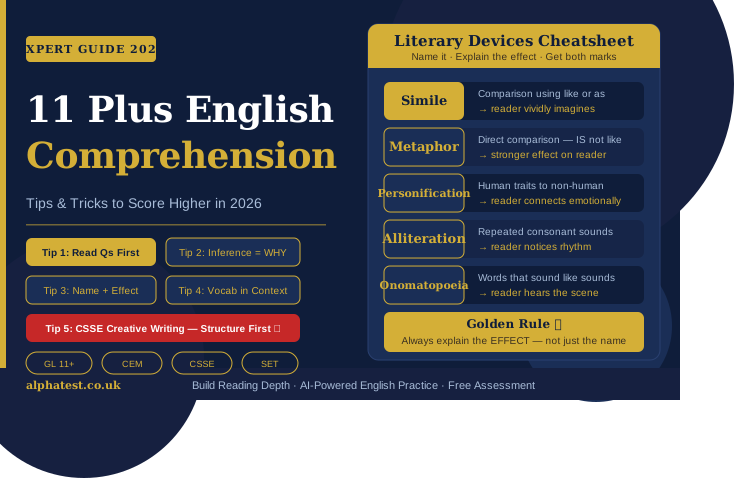
Why 11 Plus English Comprehension Separates the Top Scorers From Everyone Else
In the 11 plus exam, maths scores tend to cluster. Children either know a method or they do not, and a well-prepared cohort produces scores that are close together. 11 plus English comprehension is where genuine separation happens — where children who have developed real reading depth pull meaningfully ahead of those who have only practised paper formats without building the underlying skills.
The reason is straightforward. Comprehension questions — particularly inference and literary technique questions — cannot be answered by formula. A child who has memorised twenty maths methods can apply them reliably. A child who has been told that inference means reading between the lines but has never practised doing so under pressure will freeze when a question asks: what does the author's choice of the word crept rather than walked tell us about how the character was feeling? That question rewards a child who reads widely and thinks deeply. It punishes one who has only practised retrieval.
This guide gives you the expert strategies that consistently produce higher 11+ English comprehension scores — applicable to GL Assessment, CEM 11 plus, CSSE exam, and SET exam preparation in 2026.
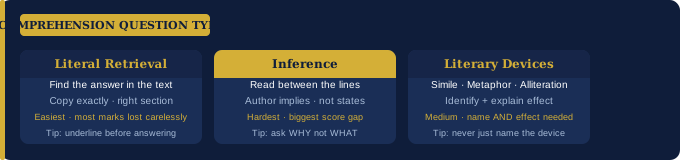
Tip 1: Read the Questions Before You Read the Passage
This single habit change produces measurable score improvement in 11 plus English comprehension papers faster than almost any other technique. Most children read the passage first, then read the questions, then search back through the passage for answers. This approach is inefficient and stressful under timed conditions.
The expert approach is different. Read every question carefully before reading the passage. Then read the passage once, underlining or mentally noting information that answers specific questions as you encounter it. By the time you reach the end of the passage, most retrieval questions are already answered in your mind. This saves minutes on a paper where minutes genuinely decide scores.
Tip 2: For Inference Questions — Always Explain the Why
Inference questions are where 11+ English comprehension marks are won and lost most dramatically. A child who answers an inference question by summarising what happened in the text — rather than explaining what the text implies — will lose those marks regardless of how well they understood the passage.
The discipline to teach is this: every inference answer must explain the why. Not what happened, but what it reveals. When a question asks what the author's use of the word trembling tells us about the character, the answer is not the character was trembling — that is retrieval. The answer is the character was afraid or nervous, because trembling suggests uncontrolled physical movement associated with strong fear. The because is the mark. Without it, the answer is incomplete regardless of how accurate the observation is.
Practice this habit in everyday reading conversations. After reading any book or article together, ask your child: why did the author write it this way? What does this word choice tell us? These conversations build inference instinct over months in a way that practice papers alone cannot.
Tip 3: Literary Devices — Name It AND Explain the Effect
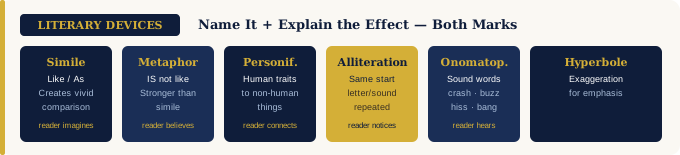
Literary device questions in 11 plus English comprehension papers carry a consistent trap that costs children marks every year. A question that asks about a simile or metaphor is not satisfied by identification alone. Naming the device earns one mark. Explaining the effect it creates on the reader earns the second — and it is the second mark that most underprepared children miss.
The literary devices that appear most frequently in GL Assessment English comprehension, CEM 11 plus comprehension, and SET exam English papers include simile, metaphor, personification, alliteration, onomatopoeia, hyperbole, and imagery. Every child should know these by name, be able to spot them instantly, and have a reliable method for explaining their effect: this device makes the reader feel, this device creates the impression of, this device helps the reader imagine.
For the CSSE exam specifically — where English responses are written rather than multiple choice — the ability to comment on literary technique in full sentences is a direct mark-earner that deserves specific written practice from Year 4 onwards.
Tip 4: Vocabulary in Context — Never Guess, Always Deduce
Vocabulary questions in 11 plus English comprehension ask children to explain what a word means as it is used in a specific sentence — not its dictionary definition in isolation. This distinction matters because many words carry different meanings in different contexts, and the exam specifically tests whether a child can deduce meaning from context rather than recall a memorised definition.
The method to teach is substitution. When a vocabulary question appears, read the sentence with the target word removed. What word or phrase would make sense in its place? That substituted meaning is typically the answer the question is looking for. A child who approaches vocabulary questions by asking what does this word mean here — in this sentence, in this context — rather than what does this word mean generally will produce more accurate answers and avoid the common error of giving a technically correct definition that does not fit the passage.
Building a strong 11 plus vocabulary list through daily reading and deliberate word study remains the most powerful long-term investment. Words like eloquent, diligent, resilient, tenacious, and formidable appear regularly across all exam boards. A child who knows these words in depth — not just their definitions but their connotations and typical contexts — has a permanent advantage on vocabulary questions that no exam technique can replicate.
Tip 5: For CSSE Creative Writing — Structure First, Language Second
For children sitting the CSSE exam, creative writing preparation deserves specific attention that most families underinvest in. The CSSE English paper requires a piece of descriptive or narrative writing assessed on structure, vocabulary, sentence variety, and engagement — and it is marked by examiners who read hundreds of scripts and notice immediately when writing is formulaic versus when it is genuinely crafted.
The most common mistake in CSSE creative writing is prioritising vocabulary over structure. A piece of writing filled with impressive words but without a clear narrative arc, a sense of atmosphere, or a satisfying conclusion reads as underdeveloped regardless of the lexical sophistication. Structure first — a compelling opening that establishes mood, a developed middle that builds tension or detail, an ending that resolves or resonates — then language choices that serve the structure.
Practise timed creative writing from Year 4 using this principle. Write for fifteen minutes, then evaluate: does it have a clear shape? Does the opening create immediate atmosphere? Does the ending feel deliberate? Then review vocabulary and sentence variety. This order of priorities produces stronger writing faster than any other approach.
The Daily Habit That Underpins Everything
Every tip in this guide builds on a single foundation that cannot be replaced by any exam technique or preparation strategy: daily reading. Thirty minutes of reading every day — quality fiction, non-fiction, and poetry — develops the inference instinct, vocabulary depth, and literary awareness that 11 plus English comprehension tests. Children who read widely answer inference questions from genuine understanding. Children who do not are always guessing.
Reading is not a preparation activity that competes with practice papers for time. It is the preparation activity that makes every other preparation activity more effective. Treat it as non-negotiable throughout the weeks remaining before exam day.
AlphaTest's English module builds vocabulary and comprehension skills daily through adaptive practice — developing the reading depth that consistently produces higher 11 plus English comprehension scores across all exam boards in 2026.
Start your child's free English comprehension assessment at AlphaTest today →
Ready to boost your child's 11+ preparation?
Try AlphaTest free — AI-powered practice, instant feedback, and gamified learning.
Start Free Trial